Introduction
A self-employed electrician turns over £58,000 a year. Every January he hands his accountant a carrier bag. Inside are about 400 receipts, statements from three bank accounts (two of them personal) and a note saying “sorry, it’s a bit of a mess this year”.
The accountant spends nine hours separating his groceries from his cable, rebuilding his mileage from his diary and guessing which payments were for materials. The fee goes up again.
There’s more. Because his qualifying income on his 2024/25 return was over £50,000, he’s been in Making Tax Digital for Income Tax since April 2026. That means quarterly updates, and the carrier bag now has to arrive four times a year.
None of that is unusual. The work was real, the expenses were genuine, and the tax is right in the end. It just costs far more than it needs to, in time and in fees.
Self-employed bookkeeping doesn’t need to be complicated. It needs to be complete, kept little and often, and in a form your accountant can use. This guide is for UK sole traders and landlords, and for accountants who want something practical to share with them.
It matters more this year than it ever has. MTD for Income Tax started on 6 April 2026, and the next group joins in April 2027. Whether you’re in that group depends on the return you file by 31 January 2027.
What follows covers small business bookkeeping in the UK from the ground up:
- the records HMRC expects you to keep, and for how long;
- cash basis or accruals;
- business and private use, mileage and working from home;
- how MTD changes the rhythm;
- a monthly routine that takes under an hour;
- what makes your accountant’s job faster, and your fee lower.
The records HMRC expects you to keep
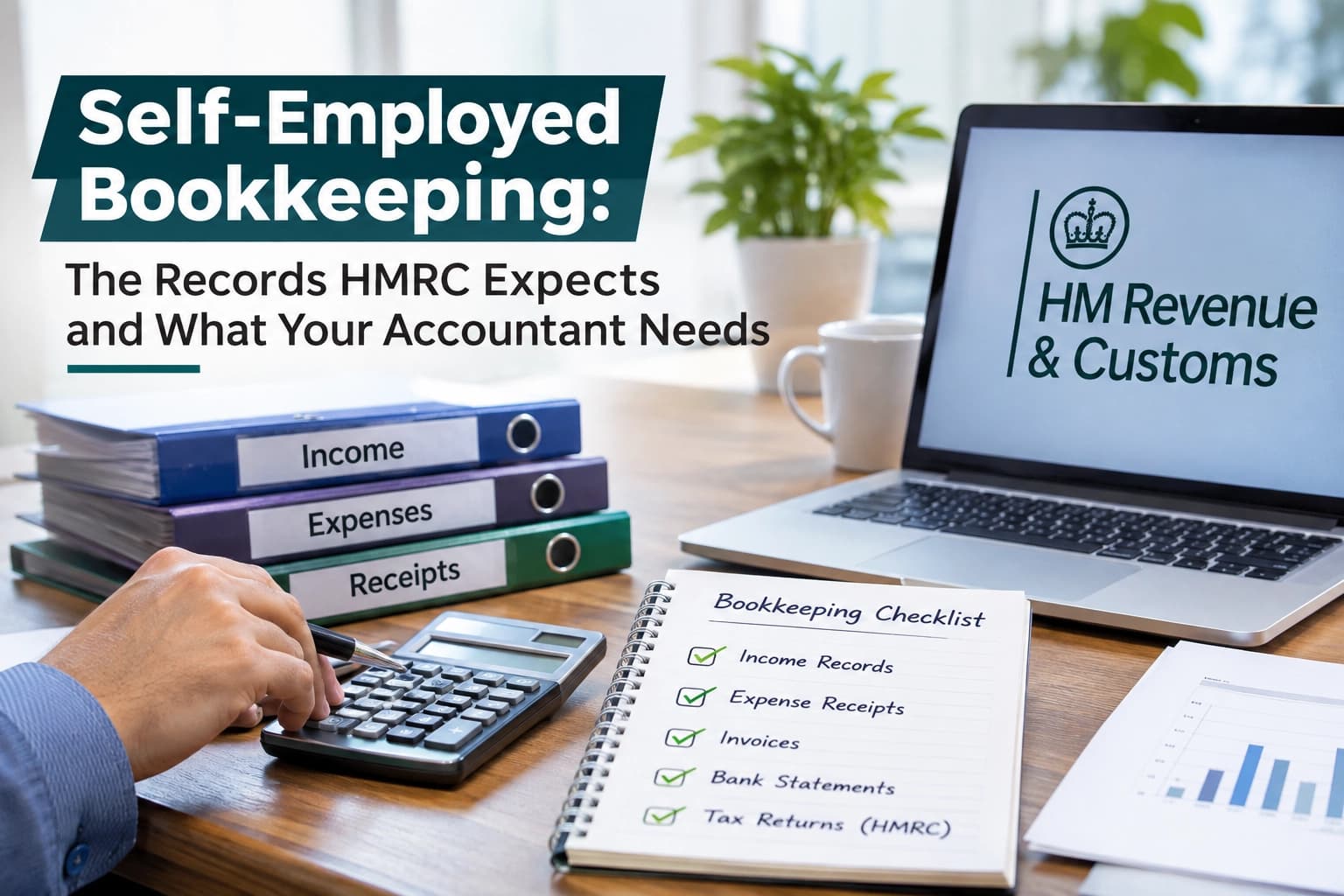
HMRC expects you to keep records of all your business income and expenses, and the evidence behind them.
| Record | What it covers | Keep it as |
| Sales and income | Invoices issued and every payment received, including cash and card takings | Copies of invoices, till records, platform statements |
| Purchases and expenses | Everything you claim as a business cost | Receipts and invoices, paper or digital |
| Bank and card statements | Every account the business uses | Statements, downloaded monthly |
| Money in and out of the business | What you put in and what you take out for yourself | A simple running note |
| Mileage log | Date, journey, purpose and miles | App, spreadsheet or notebook |
| Home-working hours | Hours worked at home each month | A monthly total |
| VAT records | If you’re VAT-registered | VAT invoices and returns |
| Payroll records | If you employ anyone | Payroll software reports |
| Amounts owed and owing | Only if you use traditional accounting | Unpaid invoices in and out |
Paper, spreadsheet or app
HMRC doesn’t dictate a format. Paper, a spreadsheet or an app can all work, as long as the records are accurate, complete and readable. This is simple bookkeeping for small business owners, and it’s all HMRC asks for. LITRG’s guide to business record-keeping is a useful plain-English companion.
Photos and scans
Photographs or scans of receipts are fine, and often better. Thermal till receipts fade, sometimes within months, and a faded receipt is no receipt at all.
How long to keep your records
For the self-employed and landlords, the rule is at least five years after the 31 January filing deadline for the tax year.
| Tax year | Filing deadline | Keep records until at least |
| 2023/24 | 31 January 2025 | 31 January 2030 |
| 2024/25 | 31 January 2026 | 31 January 2031 |
| 2025/26 | 31 January 2027 | 31 January 2032 |
Late returns
If a return is filed very late, more than four years after the deadline, the records must be kept for 15 months after it was sent. Keep records longer if HMRC has opened an enquiry.
If records are lost or destroyed
If records can’t be replaced, HMRC expects you to do your best to provide figures. You must say on the return that you’ve used estimated or provisional figures. That’s a safety net, not a strategy. The official reference is GOV.UK’s guidance on business records if you’re self-employed.
Cash basis or accruals: which applies to you
What changed in 2024/25
Since the 2024/25 tax year, the cash basis has been the default for sole traders and partnerships. You record income when it’s received and expenses when they’re paid.
The old turnover limits have gone, and the restrictions on loss relief and interest costs were removed at the same time. If you’d rather use traditional (accruals) accounting, you opt out by ticking a box on your tax return.
Which suits which business
| Type of business | Usually suits | Why |
| Freelancer, consultant or tradesperson invoicing as they go | Cash basis | Simpler, and matches how money actually moves |
| Business holding significant stock or work in progress | Accruals | Matches costs to the sales they produce |
| Business with large invoices straddling tax years | Accruals | Avoids profit swinging between years |
| Business seeking a loan or mortgage | Often accruals | Lenders may prefer accounts on a traditional basis |
Whichever you use, apply it consistently and tell your accountant, because it changes the records they need.
Business and private use
Many self-employed people use the same phone, car, home and sometimes bank account for business and personal life. That’s fine, but only the business share is an allowable expense. HMRC expects you to be able to explain how you worked it out.
Apportionment that holds up
Pick a reasonable basis and write it down. For example:
- the share of phone use that’s business;
- the proportion of a room used as an office;
- the percentage of miles driven for work.
Keep the working with your records and apply it consistently from year to year. A sensible, consistent method is far easier to defend than a different guess every year.
A separate bank account
Use a separate bank account for the business wherever you can. It isn’t a legal requirement for a sole trader, but it’s the single change that makes the biggest difference to how long your bookkeeping takes.
Mileage and working from home
Simplified expenses let sole traders and partners claim some costs at flat rates instead of working out the actual figures.
Mileage
| Vehicle | First 10,000 business miles in the tax year | Each mile after that |
| Car or van | 45p | 25p |
| Motorcycle | 24p | 24p |
Someone driving 12,500 business miles in a car claims £4,500 for the first 10,000 miles and £625 for the rest, £5,125 in total.
You still need a mileage log showing the date, journey, purpose and miles. Once you’ve used the flat rate for a particular vehicle, you have to stick with it for as long as that vehicle is used in the business. Parking and tolls on business journeys can be claimed on top.
Working from home
| Hours worked at home each month | Flat rate per month |
| 25 to 50 | £10 |
| 51 to 100 | £18 |
| 101 or more | £26 |
The flat rate covers household running costs such as heating and electricity, but not phone or broadband. You claim those separately on their business proportion.
A worked example: flat rate or actual costs?
Two designers each work about 120 hours a month at home, and each home costs £2,400 a year to heat, light and power. The office is one of five similar rooms.
| Flat rate for the year | Actual costs | |
| Designer A: spare room used for work about half the time | £312 | £240 (£2,400 × 1/5 × 50%) |
| Designer B: dedicated office used only for work | £312 | £480 (£2,400 × 1/5) |
Illustrative only. The flat rate suits Designer A; actual costs suit Designer B. HMRC’s guidance includes a checker that compares the two.
How MTD for Income Tax changes the rhythm
Who’s in, and when
| Qualifying income | Measured on | MTD applies from |
| Over £50,000 | 2024/25 tax return | 6 April 2026 |
| Over £30,000 | 2025/26 tax return | 6 April 2027 |
| Over £20,000 | 2026/27 tax return | 6 April 2028 |
What qualifying income means
Qualifying income is your total turnover from self-employment plus your gross rents from property, before expenses. Employment income and dividends don’t count. So someone with £30,000 of self-employed income and £25,000 of rent is over the £50,000 threshold, even if their profit is far lower.
Quarterly updates and deadlines
| Quarter | Period | Update due |
| 1 | 6 April to 5 July | 7 August |
| 2 | 6 July to 5 October | 7 November |
| 3 | 6 October to 5 January | 7 February |
| 4 | 6 January to 5 April | 7 May |
| Final declaration | Whole tax year | 31 January after the tax year |
A quarterly update is a summary, not a tax return, and no tax is payable when you send it. Each business needs its own update, so self-employment and property income are reported separately.
Penalties and the first-year soft landing
HMRC has said it won’t penalise late quarterly updates during 2026/27 while people adjust. The deadlines still apply, though, and normal penalty points are expected after that. The annual deadline still matters as much as ever.
Spreadsheets and bridging software
You need digital records kept in compatible software. A spreadsheet still works if it connects to HMRC through bridging software.
[Diagram suggestion: the MTD year · 4 quarterly updates and 1 final declaration on a 12-month timeline. Caption: four summaries during the year, one final return after it.]
A monthly routine that takes under an hour
Book keeping for a small business doesn’t have to take over your evenings. Most of the pain comes from doing it once a year. Done monthly, it’s quick.
- Capture receipts (10 minutes). Photograph or forward every receipt and invoice from the month into your app or one folder, named by date.
- Go through the bank (20 minutes). Categorise every transaction in your business account and match it to its receipt. Note anything you can’t identify while you still remember it.
- Record what didn’t go through the bank (10 minutes). Cash takings, cash expenses and business costs paid from a personal card.
- Update mileage and home-working hours (5 minutes). Add the month’s journeys and total your hours worked at home.
- Check who owes you (5 minutes). See which invoices have been paid and chase anything overdue.
That’s under an hour. If you’re in MTD, a slightly longer version at the end of each quarter means your quarterly update is mostly done before you start it.
What makes your accountant’s job faster (and your fee lower)
Accountants price on time and risk, and anything that reduces either tends to show up in the fee. Easy bookkeeping for small business owners and lower fees go together.
- A separate business bank account, so nobody is sorting your groceries from your stock purchases.
- Records sent in one go, not in instalments over several weeks.
- Receipts matched to bank transactions, not just dropped in a folder.
- A short note of anything unusual: a new van, a large one-off job, a loan, or a change in how you work.
- Mileage and home-working hours already totalled.
- Answers to their questions in a single reply.
- An early warning if your income is approaching an MTD threshold or the £90,000 VAT registration threshold, so they can plan rather than react.
None of this needs expertise. It just needs a little done regularly instead of a lot done at once.
Landlords: what’s the same and what’s different
Landlords keep broadly the same records: rent received, property expenses, and the evidence behind both, for the same five-year period.
For residential property, mortgage interest isn’t deducted as an expense. Instead it gives a basic-rate tax reduction, so keep the lender’s annual statements.
Gross rents count towards MTD qualifying income. A landlord who also has self-employed income can cross the threshold sooner than expected. Where property is jointly owned, each owner looks at their own share of the rent.
Frequently asked questions
Do I need a separate business bank account as a sole trader?
It isn’t a legal requirement, but it’s the most useful thing you can do for your bookkeeping. It keeps personal spending out of your figures, makes matching receipts quicker and cuts the time your accountant spends sorting transactions, which usually lowers the fee.
How long do I need to keep records if I’m self-employed?
At least five years after the 31 January filing deadline for the tax year. For 2025/26, with a filing deadline of 31 January 2027, that means keeping records until at least 31 January 2032.
Can I keep photos of receipts instead of the paper originals?
Yes. HMRC doesn’t prescribe a format, so clear, complete and readable photos or scans are fine. They’re often better than paper, because thermal till receipts fade.
Can I use a spreadsheet for self-employed bookkeeping?
Yes. A spreadsheet works well for many sole traders with modest transaction volumes. If you’re within Making Tax Digital for Income Tax, you’ll need bridging software that connects the spreadsheet to HMRC.
What’s the easiest way to do bookkeeping for a small business?
It comes down to three habits:
- one bank account just for the business;
- one place where every receipt goes;
- a short monthly session to categorise and match transactions.
Most sole traders can use the cash basis, which keeps things simple.
What is the best bookkeeping software for a small business in the UK?
The best bookkeeping for small business owners is the system you’ll actually keep up with and your accountant can access. Xero, QuickBooks, FreeAgent and Sage are common choices. If you’re in MTD for Income Tax, check the software is HMRC-recognised.
Do I have to join Making Tax Digital for Income Tax?
You must join if your qualifying income was over £50,000 on your 2024/25 return. Qualifying income means turnover from self-employment plus gross property income. The threshold drops to £30,000 from April 2027 and £20,000 from April 2028.
Does MTD mean I pay tax every quarter?
No. Quarterly updates are summaries of income and expenses, and no tax is payable when you send them. You still pay through Self Assessment, with the final declaration due by 31 January after the tax year.
What happens if I lose my business records?
If they can’t be replaced, HMRC expects you to work out the figures as accurately as you can. You must say on your tax return that you’ve used estimated or provisional figures. HMRC can charge penalties if records aren’t accurate and complete.
Can I claim working from home expenses if I’m self-employed?
Yes. You can claim a share of actual household running costs. Or, if you work at least 25 hours a month from home, you can use HMRC’s flat rate: £10, £18 or £26 a month depending on hours. Phone and broadband are claimed separately.
Can I claim mileage and fuel costs for the same car?
Not both. You either claim the flat mileage rate, which covers fuel, insurance and running costs, or the actual business share of those costs. Once you use the flat rate for a vehicle, you must keep using it for that vehicle.
What expenses can’t I claim as a sole trader?
You can’t claim:
- personal spending, or the private share of mixed-use costs;
- fines and client entertainment;
- everyday clothing.
Uniforms and protective clothing are the exception. If you’re unsure whether something counts, keep the receipt and ask your accountant.
Do landlords need to keep the same kind of records?
Broadly, yes. Landlords should keep records of rent received and property expenses for the same five-year period after the filing deadline. Gross rents count towards Making Tax Digital qualifying income.
Helping self-employed clients keep records HMRC will accept
Most of what goes wrong in a sole trader’s tax return is decided long before January. A receipt that faded in a wallet, a personal account used for business, a mileage log rebuilt from memory, a quarter’s MTD update sent from guesses. By the time the carrier bag reaches your desk, fixing those is slow and expensive.
We work as the back office for UK accountancy practices with sole trader and landlord portfolios. That means self assessment returns for sole traders, landlords and directors, prepared under your review. It also means year-round bookkeeping that keeps MTD quarterly figures current.
For property-heavy portfolios, our property and landlord accounting support covers rental income accounts and capital gains computations. Standard jobs come back within five working days.
If you’d rather test it than take our word for it, send us one real self-employed client, ideally the one who still arrives with a carrier bag. We’ll turn it into reconciled records and a return your reviewer can sign.
Start a free trial or talk to our self assessment team.
Related reading: UK Tax Self Assessment: Who Must File, What Changed, and the Deadlines That Matter | [Self Assessment Filing Errors: Twelve That Generate the Most HMRC Correspondence] | Outsourced bookkeeping services UK
This article is general guidance for UK sole traders, landlords and their accountants and is not a substitute for advice on your own circumstances. Record-keeping rules, simplified expense rates, MTD dates and thresholds are those in force as at October 2026 and may change.
Need help outsourcing this to a specialist team?
We handle bookkeeping, VAT, payroll, and year end accounts for UK accounting firms from India. Start with a free trial. No commitment required.