A hospitality VAT return is almost never wrong because someone miscalculated it. It is wrong because a till button was mapped to the wrong rate eighteen months ago and nobody has checked since. This article works through where the rate actually changes – eat-in and takeaway, hot and cold, catering, service charges, deposits and accommodation – and then through the till-level and scheme-level errors that turn into assessments.
The £80 button nobody checked
A cafe adds a toasted sandwich to the menu. Someone sets up the till button, copies the settings from the cold sandwich next to it, and the new item inherits a zero rate. It sells eleven a day at £7.50. Nobody notices, because the VAT return reconciles perfectly to the till reports every quarter – the till is simply reporting the wrong rate consistently.
Eighteen months later, that is roughly £24,000 of sales taxed at zero that should have been standard-rated, and about £4,000 of VAT, before interest or penalties. The arithmetic was never wrong. The mapping was.
This is the shape of almost every hospitality VAT problem. The rules themselves are stable and published; what moves is the menu, the till, the delivery platform and the seating. A restaurant changes its offer three times a year, and each change is a VAT decision made by whoever happens to be adding the product.
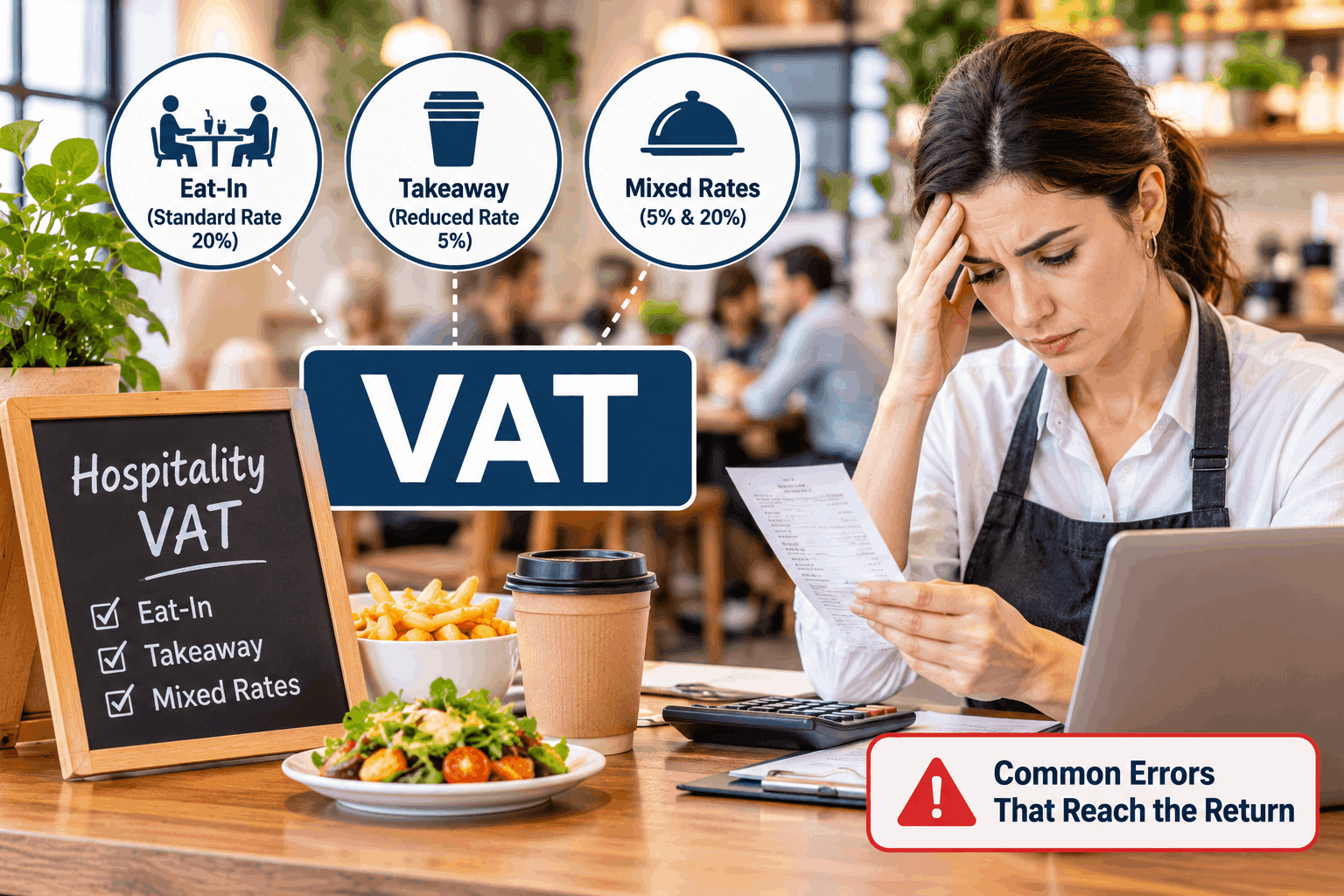
What makes hospitality harder than most sectors is that a single site can be making supplies at three different treatments in the same transaction: a hot main eaten in at 20%, a cold sandwich taken away at 0%, and a genuinely optional service charge outside the scope of VAT altogether. The question is never “what rate does this business charge”. It is “what rate does this line of this sale carry”, and the only system that can answer it at volume is the till.
This article covers where the rate actually changes, then the two places the error is created in practice: the EPOS mapping and the choice of VAT scheme. The rules are those in VAT Act 1994 Schedule 8 Group 1 and HMRC’s Notices 709/1, 701/14 and 709/3.
Why the return breaks at the till, not in the ledger
In most sectors, the VAT return is built from invoices. Each invoice carries a rate; the rate was decided by someone who thought about it, and the bookkeeping either picks it up correctly or does not.
Hospitality does not work that way. The return is built from till summaries, and the rate on every one of thousands of small transactions was decided once, in advance, when the product was set up. By the time a figure reaches the ledger, the VAT decision is already made and invisible. A bookkeeper looking at “Food sales – zero rated £18,400” has no way of knowing whether that figure is right, because the evidence sits in the product file of the till, not in the accounting records.
Three consequences follow, and they explain most of what goes wrong.
A consistent error reconciles perfectly. If the till says zero and the ledger says zero, every control in the bookkeeping agrees. Reconciliation confirms the figures match each other; it says nothing about whether the rate was right. An error in the mapping is therefore invisible to exactly the checks a practice normally relies on.
The error compounds at transaction volume. A mis-rated invoice is one error. A mis-mapped till button is an error repeated every time the item sells, which for a popular product is thousands of times a quarter.
Nobody owns the decision. The person who adds a menu item to the till is usually a manager or a supervisor, not the bookkeeper and certainly not the accountant. They are making a tax decision as a side effect of a menu change, generally without being told that is what they are doing.
Which is why the useful control in hospitality is not a better reconciliation. It is a periodic review of the product file against the menu – and a rule that new items cannot go live until their rate has been confirmed.
The eat-in line, the premises test, and hot food
Two separate questions decide the rate on a food sale, and they have to be asked in order.
Question one: is it consumed on the premises?
If food or drink is supplied for consumption on the premises where it is supplied, it is standard-rated at 20% – hot or cold, whatever the food is. That is the position in Notice 709/1, and it is the single most important line in hospitality VAT because it disposes of the question entirely. A cold sandwich eaten at one of your tables is 20%. The same sandwich handed over to be eaten elsewhere is a different supply.
“Premises” is broader than the four walls of the dining room. It extends to areas provided by the supplier for customers to consume food, including tables outside and, in many cases, communal or shared seating that the business has provided or contributed to. This is where food courts, shopping-centre units and pubs with outdoor areas get into difficulty: the business treats sales as takeaway because there is no table service, while the seating it supplies points the other way.
The practical test for an operator is not whether a customer sits down. It is whether the business has provided somewhere to sit. Get that wrong across a seating area, and the error applies to every cold item sold.
Question two: if it is takeaway, is it hot?
Cold takeaway food is generally zero-rated. Hot takeaway food and hot takeaway drinks are standard-rated. The statutory definition of “hot” is more precise than most menus assume, and it has two parts.
First, a precondition: the food, or any part of it, must be above the ambient air temperature at the moment it is provided to the customer.
Second, once that precondition is met, the supply is standard-rated if it satisfies any one of five tests in Note 3B of Schedule 8 Group 1. The food:
1. has been heated for the purposes of enabling it to be consumed hot;
2. has been heated to order;
3. has been kept hot after being heated;
4. is provided in packaging that retains heat, or in other packaging specifically designed for hot food; or
5. is advertised or marketed in a way that indicates it is supplied hot.
Any one is enough. That is the detail operators most often get wrong, because they assume a defence on one test settles the matter.
Why the fifth test catches people
The marketing test has no connection to temperature at the point of sale. Describe something on a menu or a sign as “hot”, “freshly baked and served warm”, or “straight from the oven,” and you have arguably satisfied test five on your own wording, whatever the product is doing in the cabinet.
The counterweight is that the precondition still has to be met, and the tests themselves turn on intention and presentation rather than physics. In the First-tier Tribunal case concerning Morrisons’ chicken products – a dispute reported at around £17 million – the tribunal found the products failed the first test: the packaging told customers to eat within two hours or refrigerate, and the evidence was that most were bought as part of a larger shop, so there was no implied bargain that the food had been heated in order to be eaten hot.
The lesson for a smaller operator is not that the tests are easy to defeat. It is that the answer depends on how the product is packaged, described and sold – which means menu wording and packaging choices are VAT decisions, and should be reviewed as such whenever either changes.
Cold food, meal deals and the always-standard list
Zero-rating for cold takeaway food is the general rule, not a universal one. A list of items is standard-rated however you sell them — cold, taken away, whatever the context:
• confectionery, including most chocolate-covered biscuits and sweets
• potato crisps and similar savoury snacks
• soft drinks, including bottled water and most juices
• ice cream and similar frozen products
• alcoholic drinks
For a cafe or sandwich shop, this list is most of the counter. A meal of a cold sandwich, a bag of crisps and a bottle of water sold to take away is one zero-rated item and two standard-rated ones, and a till that treats the whole transaction as a single zero-rated food sale is understating VAT on roughly half of it.
Meal deals and mixed-rate bundles
A fixed-price bundle containing items at different rates is a mixed supply, and the single price has to be apportioned between the elements. The method must be fair and consistently applied, and it has to be documented – that documentation is what an officer asks for.
Two defensible approaches are common. Apportion by the normal selling prices of the components, which is the usual starting point and the easier one to evidence. Or apportion by cost, which can give a different and sometimes better answer where the margins on the components differ sharply. What is not defensible is picking whichever split produces the lowest VAT and leaving no record of the basis.
The practical problem is that a meal deal is usually set up in the till as one product at one rate. Where that happens, the apportionment exists only as an adjustment made outside the system – which means it is made once, by one person, and tends to stop happening when that person leaves.
The eat-in uplift
Many operators charge a higher price for eating in than for taking away, which is a sensible commercial response to the rate difference. Two points follow.
The price difference does not decide the VAT treatment; the nature of the supply does. And the till has to capture the customer’s choice at the point of sale, because that choice is the evidence for the rate applied. A till that defaults to one option and relies on staff to override it will record whatever the default is, and the default is what the officer will see.
Catering, functions and delivery platforms
Catering is standard-rated whatever the food is
A supply made in the course of catering is standard-rated regardless of the underlying food. That matters because “catering” is wider than restaurant service: it covers supplies of prepared food with the services that normally go with it – delivery to a venue, laying out, serving, staff, crockery, clearing away.
So a cold buffet is a useful illustration. Sold as cold food over a counter, the food elements would largely be zero-rated. Delivered to an office with staff to set it up and clear it away, it is catering, and the whole supply is standard-rated. The food did not change; the supply did.
This catches operators who move into event or office catering from a retail base, because the pricing is often built on the retail VAT assumption and the margin is then wrong by 20%.
Functions, weddings and the single supply question
A function priced as a package – room, food, drinks, staff – is normally a single standard-rated supply of catering, and trying to break out individual elements to find a lower rate rarely succeeds. The exception that is worth getting right is room hire. Bare room hire can be exempt, but where the room is hired together with catering, the hire is generally part of a single catering supply and follows it.
The practical point for a venue is that the contract and the invoice should describe the same thing. An invoice that itemises “room hire – exempt” against a contract for a wedding package is the kind of inconsistency that invites a review of every function in the period.
Delivery platforms
Third-party delivery has quietly become one of the larger VAT risks in the sector, for three reasons.
Almost everything sold through a hot-food delivery platform is standard-rated. Food ordered to be delivered hot will usually be kept hot, packaged to retain heat and marketed as hot – three of the five tests, any one of which is sufficient. Treating platform sales as takeaway at the zero rate because the customer is not on the premises is the error, and it is a large one at platform volumes.
The commission is a separate supply to you. The platform’s commission is a supply of services to the restaurant, and the VAT on it is input tax recoverable in the normal way – subject to holding a valid invoice. Netting the commission off the sales figure and declaring only what landed in the bank understates output tax and loses the input tax.
Platform sales often bypass the till. Where orders arrive on a tablet and are keyed in later, or not at all, the till product file is no longer the record of what was sold. The platform’s own reporting then has to be mapped to rates, reconciled to the sales ledger, and kept – and the gross-to-net reconciliation between platform statements and bank receipts becomes a monthly control rather than an annual tidy-up.
Service charges, tips, deposits and no-shows
Service charges turn on whether the customer had a choice
The distinction is simple to state and easy to lose in practice.
| Payment | VAT treatment |
| Mandatory service charge the customer must pay | Part of the consideration for the meal, standard-rated |
| Genuinely optional or discretionary service charge | Outside the scope of VAT |
| Tip freely given by the customer above the total bill | Outside the scope of VAT |
Notice 709/1 puts it plainly: if you make a service charge it is standard-rated, while a tip freely given over and above the total charge carries no VAT. What makes a charge optional is that it is clearly presented to the customer as entirely optional, and that a customer who asks for it to be removed gets it removed.
One detail worth knowing: HMRC’s own guidance treats the menu as setting the contract between the restaurant and the customer. A charge described as optional on the menu cannot be made compulsory when the bill arrives. So the menu wording and the till’s behaviour have to agree — and if the EPOS adds the charge with no practical way for staff to take it off, the “discretionary” label is doing no work.
Tips and service charges also carry a separate employment-tax question. Where mandatory service charges are passed to employees, they are treated as earnings, with PAYE and National Insurance consequences, and the tronc arrangements that govern distribution sit alongside the Employment (Allocation of Tips) Act obligations. That is a payroll matter as much as a VAT one, and the two are often decided separately by different people in the same business, which is how they end up inconsistent.
Deposits create a tax point when you take them
VAT on a deposit is due on receipt of the payment, or on the issue of a VAT invoice, whichever happens first. There is no waiting for the meal, the function or the stay.
The harder question is what happens when the customer never arrives, and HMRC’s position here changed and still catches operators working from older guidance.
Before 1 March 2019, a retained deposit or no-show charge could be treated as outside the scope of VAT, on the basis that nothing had been supplied and the payment was compensation. Following Revenue and Customs Brief 13 (2018) – itself following CJEU decisions including Air France-KLM – that is no longer the position. VAT is due on retained payments for unused services and uncollected goods.
HMRC’s internal guidance on hotel no-shows states the principle directly: a retained deposit or no-show charge is subject to VAT, because the amount paid on account is consideration for the customer’s right to benefit from the performance of the contract, whether or not the customer exercises that right. Taking the payment creates a chargeable event, and the payment cannot be retrospectively re-characterised as an outside-the-scope compensation payment.
The practical consequences:
• A cancellation fee or no-show charge retained from a deposit stays standard-rated. Do not credit the VAT back.
• Where the customer receives a full refund, the supply does not happen, and the output tax can be adjusted.
• A partial refund needs the retained element treating as consideration and the refunded element adjusting.
• “Non-refundable” is a commercial label, not a VAT one. It does not move the treatment outside the scope.
Christmas function deposits are where this bites hardest, because the deposits are taken in one VAT quarter and the cancellations land in the next. The deposit ledger has to be visible to whoever prepares the return, or the adjustments get made on memory.
Accommodation and the 28-day reduced value rule
Sleeping accommodation in a hotel, inn, guest house or similar establishment is standard-rated. The relief worth knowing is the reduced value rule for long stays, set out in paragraph 9 of Schedule 6 to the VAT Act 1994 and explained in section 3 of Notice 709/3.
Where an individual stays for more than 28 consecutive days, the charge for the actual sleeping accommodation element is relieved from VAT from day 29 onwards. VAT continues to be due on the facilities element, which must be treated as at least 20% of the charge.
Worked example
A contractor stays 45 consecutive nights at £150 a night plus VAT.
| Period | Nights | Value | VAT |
| Days 1 to 28, full value at 20% | 28 | £4,200 | £840.00 |
| Days 29 to 45, facilities element only (minimum 20% of £2,550 = £510) | 17 | £2,550 | £102.00 |
| Total | 45 | £6,750 | £942.00 |
From day 29, the effective VAT rate on the charge falls to around 4%. On a 45-night stay, that is roughly £408 of VAT that does not arise, which is material on a room sold at a corporate rate.
Four things that go wrong with it
It is relief on value, not an exemption. The supply stays taxable; VAT is simply computed on a reduced value. That means input tax recovery is unaffected, and the income still counts as taxable turnover for registration and scheme purposes. Treating long-stay income as exempt leads to an unnecessary partial exemption calculation and an understated turnover figure.
The first 28 days are charged in full. The mirror error – applying the day-29 basis across the whole stay – understates VAT on the first four weeks. The rule does not apply retrospectively to the earlier nights once the stay passes 28 days.
It follows the individual, not the invoice. HMRC accepts that the rule can apply where the supply is made to someone other than the guest, such as an employer or an agency paying for a contractor, provided the same individual actually occupies the room for more than 28 days. So a single invoice to a company covering a rotating series of different occupants does not qualify, even if the room was continuously occupied.
It does not apply to holiday accommodation. Notice 709/3 excludes holiday accommodation from the reduced value rule, which matters for operators running a mixed estate of hotel rooms and holiday lets.
The control is a report of guests whose continuous stay is approaching 28 nights, run weekly from the property management system. Hotels with a contractor or relocation book usually find stays that crossed the line and were billed at the full rate throughout – which is VAT the business has paid over and could have avoided.
EPOS mapping: where the error is created
This is the part of hospitality VAT that almost nothing published covers, and it is where the money actually goes. The rules above are only as good as the till that applies them.
A till product file needs four things to produce a defensible VAT analysis.
1. Every product mapped to a rate, deliberately. Not inherited from whatever item was duplicated to create it. The review is a list of products against rates, read alongside the menu, by someone who knows the rules. For most sites, that is an hour’s work, and it is the single highest-value hour in the whole process.
2. An eat-in and takeaway distinction that the till enforces. Items that change rate with the customer’s choice need either two buttons or a transaction-level toggle that cannot be skipped. If the toggle can be ignored, the till records the default, and the default becomes the position the business has to defend for every sale.
3. Modifiers that carry their own rate. Toasting a sandwich, adding a hot side, making a cold drink hot – each can move the line from zero to standard. Where modifiers sit outside the rate logic, the base item’s rate is applied to a supply that has changed character.
4. Reports that break takings down by rate and by channel. Eat-in, takeaway, delivery platform and function income, each analysed by rate. A single daily takings figure cannot support a VAT return, and it cannot be audited after the fact.
A review that is worth running quarterly
The check that finds the most is also the simplest: export the product file, sort by VAT rate, and read the zero-rated list. Every item on it should be obviously cold food that is not on the always-standard list. Anything hot, anything described as hot, any drink other than plain milk or tea and coffee to take away, any crisps, confectionery, or bottled water sitting in the zero-rated group is an error to investigate.
Then do the reverse: read the standard-rated list for cold takeaway items that should be zero-rated. Operators tend to assume errors only run one way. They do not, and overpaid VAT is just as much a reason to fix the mapping – it is simply one HMRC will not write to you about.
This is where bookkeeping and VAT returns have to meet the operational system rather than stop at the ledger. A practice that only ever sees the monthly summary cannot find these errors, because by the time the figure reaches the trial balance, the decision is already baked in.
Choosing a scheme
Registration is compulsory once taxable turnover in any rolling 12-month period passes £90,000, a threshold unchanged since 1 April 2024. The deregistration threshold is £88,000. For a seasonal business, the rolling test matters more than the annual figure, because a strong summer can take a rolling 12 months over the line even where the accounting year stays under it.
The Flat Rate Scheme is usually the wrong answer in food
The Flat Rate Scheme is open to businesses expecting VAT-taxable turnover of £150,000 or less excluding VAT, with a £230,000 exit threshold. The hospitality percentages are 12.5% for catering including restaurants and takeaways, 6.5% for pubs, and 10.5% for hotels and accommodation, each reduced by one percentage point in the first year of registration.
Those look attractive next to 20%, and for a pub they often are. For a food business with meaningful zero-rated sales, they usually are not, for one reason that is easy to miss: the flat rate applies to all VAT-inclusive turnover, including sales that would otherwise be zero-rated.
So a sandwich shop with a large cold takeaway trade pays 12.5% on income it would otherwise pay nothing on. The scheme turns a zero-rated sale into a taxed one. Two further limits compound it: input VAT cannot be recovered except on a single capital purchase of £2,000 or more including VAT, and a business spending less than 2% of its VAT-inclusive turnover on goods, or less than £1,000 a year, is a limited cost business and must use 16.5% whatever its sector.
The test is arithmetic, not judgement. Model the flat rate against normal accounting on last year’s actual mix before joining, and re-run it whenever the eat-in to takeaway balance shifts.
Retail schemes, and the catering problem
Retail schemes exist for businesses selling at more than one rate to the public without issuing invoices. There are three, with two variants each for apportionment and direct calculation.
| Scheme | What it does | Turnover limit (excl VAT) |
| Point of Sale | Identify the rate on each sale as it is made | Up to £130 million |
| Apportionment 1 | Split total takings using the ratio of purchases at each rate | Up to £1 million |
| Apportionment 2 | As above, for larger businesses | Up to £130 million |
| Direct Calculation 1 | Value the minority-rate goods, treat the rest as the other rate | Up to £1 million |
| Direct Calculation 2 | As above, for larger businesses | Up to £130 million |
Above £130 million of retail turnover, no standard scheme is available, and a bespoke scheme has to be agreed with HMRC.
The important restriction for this sector: the apportionment schemes can only be used by businesses that buy goods for resale, and cannot be used for supplies of services. Catering is a supply of services, which puts the apportionment schemes out of reach for most restaurant and cafe operations – a point worth checking against your own mix before assuming apportionment is available, because the scheme is often suggested for hospitality by people working from general retail guidance.
In practice, that leaves two realistic routes. Point of Sale, where the till does the work and the mapping is therefore everything – which is the normal and better answer. Or Direct Calculation, where one rate dominates, and the minority can be valued reliably, which can suit a business whose zero-rated sales are a small and well-defined group of bought-in items.
Whichever applies, the scheme has to be a decision on file with a documented basis, not an inherited habit. An officer will ask which scheme is in use and how the figures were arrived at, and “this is how the till has always reported it” is not an answer. Getting the sales analysis right also improves the management accounts, since the same split by rate and channel is what tells an operator where the margin actually sits.
The errors that trigger an assessment
Assessments in this sector rarely come from a single large mistake. They come from a small error applied consistently, found on a visit, and then projected across the whole period. Ranked by how often they turn up:
1. A product mapped to the wrong rate at set-up. The most common and the most expensive, because the error multiplies by volume and runs until someone checks the product file.
2. Eat-in sales recorded as takeaway. Either the till defaults to takeaway, or seating has been added without anyone revisiting the rate position. Cold items sold in a seating area the business provides are the exposure.
3. Delivery platform sales treated as zero-rated. Hot food delivered hot is standard-rated, and platform volumes make this a large number quickly. Netting commission off sales compounds it.
4. Service charge mapped as outside the scope when it is mandatory. Or described as discretionary on the menu while the till gives staff no way to remove it.
5. Retained deposits and no-show charges credited back. Working from pre-2019 guidance, or simply not having sight of the deposit ledger when the return is prepared.
6. Meal-deal apportionment with no documented basis. The split may even be reasonable, but with no record of the method it cannot be defended.
7. No till records retained. Digital records and a clear audit trail from takings to the return are required under Making Tax Digital for VAT, and a business that cannot produce the detail behind a box figure has little ability to argue about an assessment.
8. The reduced value rule applied from day one, or not at all. Both directions are errors; the second costs the business money rather than HMRC.
What an officer actually asks for
It is worth knowing the shape of the request, because preparing for it is most of the work:
• the current till product file, with rates
• the menu or price list for the period, and any earlier versions
• Z reads or daily takings reports for sample days, reconciled to banking
• the basis of any apportionment, in writing
• the scheme in use and when it was adopted
• delivery platform statements reconciled to the sales ledger
• the deposit and function ledger
A business that can produce that set has usually not made the errors. A business that cannot is generally about to find out which of them it has made.
Frequently asked questions
Is there VAT on takeaway food in the UK?
It depends on temperature. Cold takeaway food is generally zero-rated, and hot takeaway food and hot takeaway drinks are standard-rated at 20%. Some items are standard-rated; however, they are sold – confectionery, crisps and similar savoury snacks, soft drinks and bottled water, ice cream and alcohol – so a cold meal deal is often a mix of rates rather than a single zero-rated sale.
Do I charge VAT on a cold sandwich if the customer eats it at my table?
Yes. Anything supplied for consumption on the premises is standard-rated whether it is hot or cold. The relevant question is not whether the food is hot but whether your business has provided somewhere for the customer to eat it, which includes outside tables and, in many cases, shared or communal seating you provide.
Is a toasted sandwich standard-rated?
If it is above the ambient air temperature when you hand it over and meets any one of the five statutory hot-food tests, yes. Toasting to order satisfies the “heated to order” test on its own, so a toasted sandwich sold to take away is normally standard-rated while the same sandwich sold cold is normally zero-rated. This is the single most common till-mapping error in cafes.
Is there VAT on coffee to take away?
Yes. Hot takeaway drinks are standard-rated, so coffee and tea to take away carry VAT at 20%. Cold drinks follow their own category: a bottled soft drink or water is standard-rated regardless, while plain milk is generally zero-rated.
Do I pay VAT on a service charge?
If the charge is compulsory, it is part of the consideration for the meal and is standard-rated. A genuinely optional service charge and a tip freely given above the total bill are outside the scope of VAT. “Genuinely optional” means clearly presented as optional and actually removable on request – and HMRC treats the menu as setting the contract, so a charge described as optional there cannot become compulsory at the bill.
Is VAT due on a deposit I keep when a customer does not turn up?
Yes. VAT is due when you take the deposit, and since 1 March 2019 HMRC’s position is that VAT remains due on retained payments for unused services. A retained deposit or no-show charge cannot be re-characterised as outside-the-scope compensation after the event. If you give a full refund the supply does not happen and the output tax can be adjusted; a partial refund needs splitting between the retained and refunded elements.
Can a restaurant use the Flat Rate Scheme?
It can if expected VAT-taxable turnover is £150,000 or less excluding VAT, at 12.5% for catering, but it is often a poor choice. The flat rate applies to all VAT-inclusive turnover including sales that would otherwise be zero-rated, so a business with significant cold takeaway trade ends up paying VAT on income that would otherwise carry none. Model it against normal accounting on your actual sales mix before joining.
Does my pub pay the same VAT on food and drink?
On the premises, yes – food and drink consumed in the pub are both standard-rated, and alcohol is standard-rated wherever it is sold. The difference arises on takeaway: cold food sold to take away can be zero-rated, while hot takeaway food and any alcohol remain standard-rated. Pubs with a growing takeaway or delivery trade therefore acquire a mixed-rate problem they did not previously have.
Do I charge VAT on delivery app orders?
Almost always at 20%, because food sent out to be eaten hot will typically be kept hot, packaged to retain heat and marketed as hot – and any one of those tests is enough. Treat the platform’s commission as a separate supply of services to you, recover the input tax on a valid invoice, and declare output tax on the gross sale rather than on the net amount received.
Is there VAT on hotel rooms?
Yes, sleeping accommodation is standard-rated. The exception is the reduced value rule for long stays: where the same individual stays more than 28 consecutive days, from day 29 the sleeping accommodation element is relieved and VAT is due only on the facilities element, treated as at least 20% of the charge. It is a relief on value rather than an exemption, so the supply stays taxable and input tax recovery is unaffected.
What VAT records does a hospitality business have to keep?
Enough to show how each box on the return was arrived at. In practice that means daily takings records analysed by rate and channel, Z-reads reconciled to banking, the till product file with its rate mapping, menus for the period, the documented basis of any apportionment, delivery platform statements reconciled to the sales ledger, and the deposit ledger. Records must be kept digitally and returns filed through compatible software under Making Tax Digital for VAT.
Getting the till and the return to agree
The rules in this article are not the difficult part. They are published, they are stable, and a competent adviser can apply them to any single transaction in a minute.
What is difficult is keeping thousands of transactions a week mapped correctly while the menu changes, a delivery platform is added, outdoor seating goes in, and Christmas deposits arrive in one quarter to be cancelled in the next. That is an operational discipline rather than a technical one, and it fails quietly – which is why so many assessments in this sector come as a surprise to businesses that believed their VAT was in order.
Two things are worth doing before the next return. Read the till’s zero-rated product list against the menu. And look at how retained deposits and no-show charges were treated in the last two quarters.
If you would like a second pair of eyes on either, VAT returns and hospitality accounting are both areas Probal Global works in, and a sensible way to start is a review of one quarter’s figures against the underlying till data rather than a proposal: start with a VAT review, or talk to our team about how a hospitality file is handled end to end.
Related reading
• Our other VAT and compliance articles
This article is general guidance on UK VAT in the hospitality sector and not advice on a specific business or transaction. VAT liability depends on the precise facts of each supply, the rules and HMRC’s published guidance change, and figures are those applying at the date of publication. Confirm the current position against HMRC guidance and take advice on your own circumstances before acting.
Need help outsourcing this to a specialist team?
We handle bookkeeping, VAT, payroll, and year end accounts for UK accounting firms from India. Start with a free trial. No commitment required.