Introduction
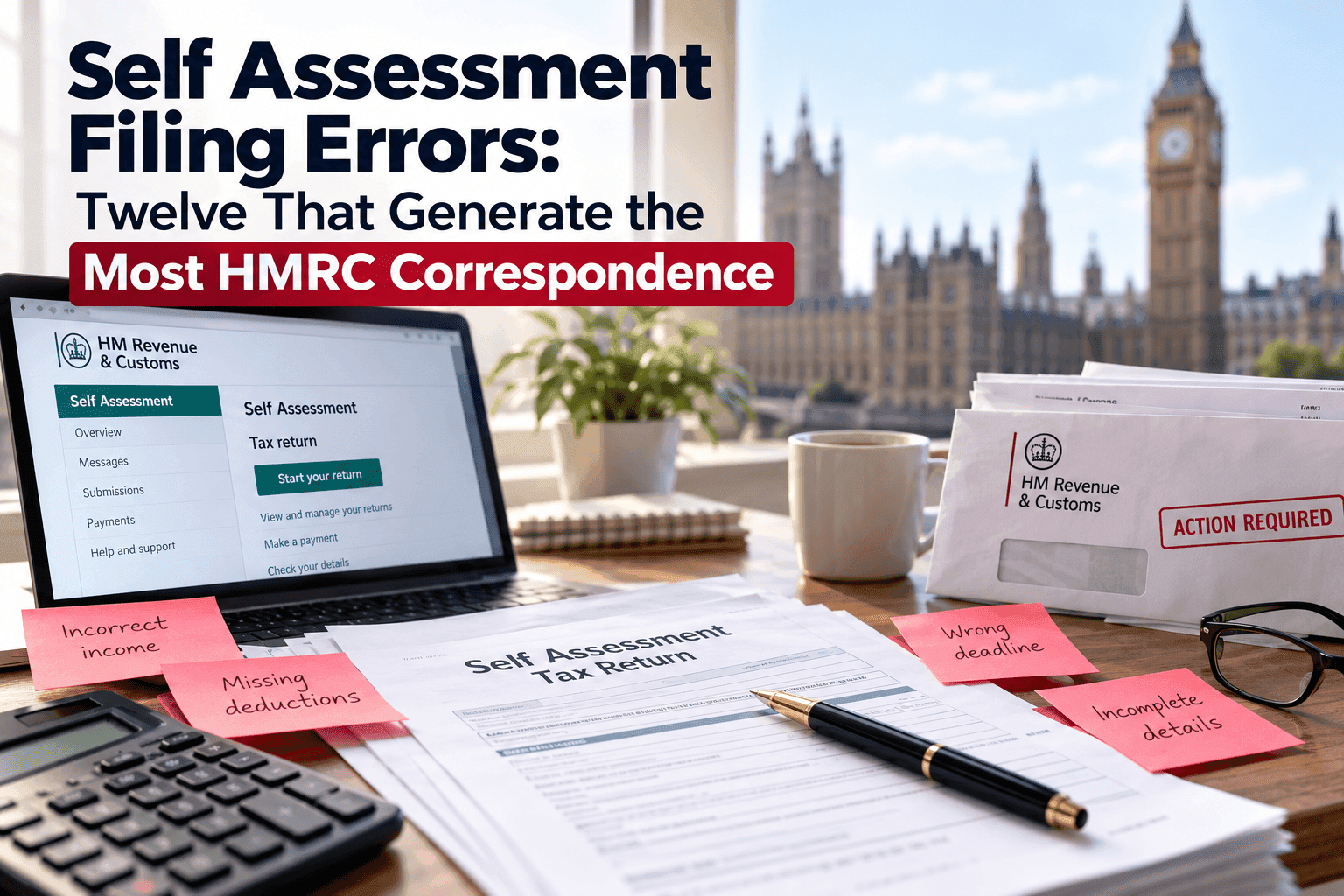
Most HMRC letters about a return aren’t enquiries. They’re mismatches. HMRC now receives data from employers through payroll, from banks, the Student Loans Company, contractors under CIS, the Child Benefit system, the Capital Gains Tax property service and overseas tax authorities, with crypto platforms joining next year. When a return doesn’t match that data, a letter follows. Sometimes it’s a correction. Sometimes it’s a check that runs for months.
The errors behind those letters aren’t exotic. We see the same twelve again and again in returns we’re asked to review or re-prepare for UK practices. Each takes minutes to get right at the point of self assessment filing. Each takes hours to unpick once HMRC has written, and the client usually pays interest on top.
HMRC’s online tax return will calculate the tax on whatever you enter. It won’t tell you that you entered the wrong thing. That’s the job of the person preparing the return, and of whoever reviews it.
For each error below we set out the symptom (what turns up in the post), the cause, and the fix. At the end there’s a short pre-submission check that covers all twelve, and what to do if a return has already gone in wrong.
Employment, student loans, pensions and dividends
1. Employment pages left out when there’s a P60
Symptom: HMRC corrects the return within nine months of filing, or a calculation arrives showing more tax than the client expected. Sometimes it surfaces months later as a P800.
Cause: The client thinks the return is only for “the extra income”, so the salary that’s already been taxed gets left out. A job held for a few weeks in April, with only a P45 to show for it, goes missing just as often. Without every employment on the return, the personal allowance and basic rate band are effectively used twice, and the calculation is wrong.
Fix: Every employment in the tax year goes on its own employment page, with pay and tax taken from the P60, P45 or final payslip. Check the figures against the PAYE record in the client’s HMRC online account. Add P11D benefits unless they were payrolled, in which case they’re already inside the P60 pay figure and adding them again double-counts. Directors need these pages too, because that’s where the close company boxes now sit.
2. Student loan plan wrongly identified
Symptom: Repayments worked out on the wrong threshold, a demand for repayments the employer already took, or a letter after the Student Loans Company’s records don’t match HMRC’s.
Cause: The wrong plan is selected, a postgraduate loan is missed, or the deductions made through payroll aren’t entered, so the return collects them a second time. For 2025/26, the repayment thresholds are £26,065 for Plan 1, £28,470 for Plan 2 and £32,745 for Plan 4, all at 9%, and £21,000 for postgraduate loans at 6%. Plan 5 repayments only began in April 2026, so they can’t belong on a 2025/26 return. The employment pages have also carried an extra box since 2024/25 that stops payrolled benefits inflating student loan repayments. Leaving it blank where it applies can overcharge.
Fix: Confirm the plan from the client’s Student Loans Company account or the plan code on their payslip, never from memory. Enter employer deductions from the P60. For self-employed borrowers, remember that the transition profit slice counts towards the repayment calculation too.
3. Pension contributions entered net, or the wrong kind entered
Symptom: Higher-rate relief under-claimed, which nobody notices, or over-claimed, which HMRC does notice and asks for evidence.
Cause: With a personal pension or SIPP under relief at source, the client pays 80% and the provider adds 20%. The return needs the gross figure, but clients usually quote what left their bank account. The opposite mistake is entering contributions deducted from gross pay under a net pay arrangement. Those have already had full relief through payroll, so entering them gives relief twice.
Example: A higher-rate taxpayer pays £8,000 into a SIPP, so the gross contribution is £10,000. Entered correctly, the basic rate band extends by £10,000 and the return gives £2,000 of extra relief. Entered as £8,000, it gives £1,600, and the client loses £400 without knowing.
Fix: Work from the provider’s annual statement showing gross contributions, and check payslips to see which arrangement a workplace scheme uses. Gross contributions also reduce adjusted net income, which matters for HICBC and the £100,000 personal allowance taper, so the knock-on effect can be worth more than the relief itself. For high earners, check the annual allowance as well.
4. Dividends from your own company understated
Symptom: A query when HMRC compares the return with the company’s records, a question about the director’s loan account, or now a £60 penalty for incomplete close company boxes.
Cause: The dividends in the company’s records don’t match the personal return. Usually that’s because the director worked to the company’s year end instead of the tax year, took money out without dividend paperwork, or forgot an interim dividend paid in March. An overdrawn loan account that’s written off counts as a distribution too.
What’s new for 2025/26: Directors of close companies must now report each company’s name and registered number, the dividends received from it (even if nil), and their highest shareholding percentage in the year. HMRC has confirmed that unpaid directors and directors of dormant close companies must complete the boxes as well.
Fix: Reconcile dividends to board minutes, vouchers and the director’s loan account by tax year, 6 April to 5 April. Timing matters more than it used to: dividends paid after 5 April 2026 are taxed at 10.75% and 35.75%, two points more than those paid before. Practices that also prepare the company’s CT600 and director payroll are best placed to tie all three together.
Savings, property, CIS and self-employment
5. Savings interest missed
Symptom: A letter, or a Simple Assessment, after banks report interest that isn’t on the return. HMRC uses this data far more actively than it once did. From October 2025 it began sending Simple Assessments for tax owed on 2024/25 bank interest.
Cause: Clients assume the personal savings allowance covers everything. At recent rates, a higher-rate taxpayer’s £500 allowance is used up by about £12,500 in an account paying 4%. Joint accounts get missed, or entered in full by both spouses. Fixed-term bonds that pay interest at maturity put several years of interest into one tax year. Overseas accounts are simply forgotten.
Fix: Ask for interest statements for every account, including joint and closed ones, and split joint interest by ownership, which is usually 50:50 for spouses. Check when bond interest was actually credited or became available. ISA interest stays off the return. The allowance is £1,000 for basic-rate taxpayers, £500 at higher rate and nothing at additional rate.
6. Property finance costs claimed as an expense
Symptom: An HMRC check on the property pages, often following a campaign letter to landlords. The adjustment comes with interest and, where HMRC decides the error was careless, a penalty of up to 30% of the extra tax.
Cause: Individual landlords of residential property can’t deduct mortgage interest. They get a basic-rate tax credit instead. Bookkeeping software that maps interest to general expenses gives a full deduction by mistake. Former holiday lets came into the restriction from 2025/26, so the treatment that was right last year is wrong this year. Broker and arrangement fees filed under professional fees cause the same problem.
Example: A higher-rate landlord deducts £9,000 of mortgage interest as an expense and saves £3,600. The correct relief is a £1,800 credit. That’s £1,800 of tax short for every year it happens.
Fix: Put residential finance costs in box 44 of the SA105 property pages, not in expenses, and carry any unused amount forward through box 45. Interest on commercial property stays fully deductible. Our landlord allowable expenses guide covers finance costs in detail. From April 2027 the credit rises to 22%, in line with the new property income rates.
7. CIS deductions that don’t match the contractor’s returns
Symptom: The return shows a refund, and the refund doesn’t arrive. HMRC holds it and writes asking for CIS deduction statements. For a subcontractor counting on that money, this is often the letter that hurts most.
Cause: HMRC checks the deductions claimed against what contractors reported on their monthly CIS returns. Mismatches come from claiming deductions worked out from bank receipts rather than statements, mixing up gross and net figures, using the wrong tax months (they run from the 6th to the 5th), or a contractor filing late or under the wrong details.
Fix: Claim only what monthly deduction statements support, reconciled to the tax year by tax month. Chase missing statements early, because contractors must issue them within 14 days of the end of each tax month. If a contractor’s figures are wrong, get them corrected at source before the return goes in. We prepare CIS returns for contractor clients, so we see this mismatch from both sides. Our post on CIS deduction statements and the 14-day rule [add link] covers what a statement must show.
8. Transition profits left off after 2023/24
Symptom: Profits that come in lower than HMRC expects. HMRC already holds the transition profit figure from the 2023/24 return, so the shortfall is easy for it to spot.
Cause: Under basis period reform, sole traders and partners whose accounting year didn’t end on 5 April or 31 March had a transition profit in 2023/24. By default it’s spread over five years, to 2027/28. Plenty of returns included the first slice and then forgot the rest, especially where the client changed accountant or a new preparer picked up the file.
Fix: Keep the transition profit schedule on the permanent file and include the right slice every year. 2025/26 is year three. If the client elected to accelerate, check what’s left to bring in. The slice also counts towards student loan repayments, so model the effect before recommending acceleration.
Child Benefit, gains, foreign income and payments
9. High Income Child Benefit Charge missed, or paid twice
Symptom: HMRC writes about an unpaid charge, because it holds the Child Benefit records. Or the client ends up paying the charge through their tax code and on their return.
Cause: The charge falls on the partner with the higher adjusted net income, not the person who claims. Preparers miss it when the client’s own income looks unremarkable but the partner’s claim is in the background. Others calculate adjusted net income without deducting gross pension contributions and Gift Aid, which can cut the charge or remove it. The newer risk comes from HMRC’s PAYE route: a client who signed up to pay through their tax code can be charged twice if the charge also goes on the return.
Fix: Ask every client with children about Child Benefit in the household and both partners’ income. Use the amount actually received in the tax year; for 2025/26 the weekly rates were £26.05 for the eldest child and £17.25 for each other child. The charge is 1% for every £200 of adjusted net income over £60,000. If the client used the PAYE service, check their coding notice before the charge goes on the return.
10. Residential property sales missed in the 60-day window
Symptom: A late filing penalty on the 60-day return, interest on tax paid late, and sometimes the same tax charged twice because the annual return didn’t credit what was already paid.
Cause: UK residents who sell UK residential property with Capital Gains Tax to pay must report and pay within 60 days of completion, through a separate CGT on UK property account. Clients often mention the sale when they send their annual records, by which time the 60 days are long gone. Non-residents must report every disposal of UK land and property within 60 days, even when there’s no tax to pay. Late 60-day returns attract penalties starting at £100.
Fix: Ask clients to tell you about a sale before completion, not after. Calculate the gain, file and pay within 60 days, and keep the reference. Then report the same disposal on the capital gains pages of the annual return and enter the tax already paid, so it’s credited. For 2025/26, residential gains are taxed at 18% and 24% after the £3,000 annual exempt amount.
11. Foreign income still filed on the remittance basis
Symptom: Letters prompted by overseas data. HMRC receives account information from tax authorities around the world under the Common Reporting Standard, and uses it to find foreign income missing from returns.
Cause: The remittance basis ended on 6 April 2025. For 2025/26, foreign income and gains are taxed as they arise, unless the client qualifies for the new four-year FIG regime, which broadly covers people in their first four years of UK residence after ten years abroad. FIG relief has to be claimed on the return every year, with the income identified. The errors we see are ticking the remittance basis out of habit, not claiming FIG relief when it’s available, missing small overseas bank accounts, and using the wrong exchange rate.
Fix: Confirm residence and the arrival year before anything else. If FIG relief applies, claim it on the return and list the income and gains it covers. Otherwise, report foreign income on the foreign pages, with foreign tax credit relief where tax was paid abroad. Clients with older unremitted income may want to look at the Temporary Repatriation Facility, which is also designated through the return.
12. Payments on account ignored
Symptom: A February phone call asking why another £4,000 is due in July. Or interest charges on payments on account that were reduced too far.
Cause: First-year clients don’t know payments on account exist, so January costs them 150% of a year’s tax. Preparers don’t flag a reduction when income has fallen, so clients overpay. Or a reduction is claimed down to nil to ease cash flow, and interest at 7.75% runs on the shortfall from 31 January and 31 July.
Fix: Send the full payment schedule with every return that goes out for approval, not just the balancing payment. Make reduction claims only on the back of a written estimate. This season, warn directors that payments on account based on 2025/26 won’t cover the higher dividend tax for 2026/27, so their January 2028 bill will be bigger than the instalments suggest.
A pre-submission check that covers all twelve
Free income tax filing through HMRC’s online service is fine for many people. What it doesn’t do is compare your figures with the data HMRC holds before you submit. HMRC does that afterwards. A twelve-line check before filing closes most of the gap:
- Every P60 and P45 for the year entered, and P11D benefits checked against payroll
- Student loan plan confirmed, and payroll deductions entered
- Pension contributions entered gross, relief at source only
- Dividends reconciled by tax year, and close company boxes complete
- Interest included from every account, with joint accounts split
- Residential finance costs in the finance costs box, not expenses
- CIS deductions matched to monthly statements
- Transition profit slice included for 2025/26
- HICBC checked against both partners’ income, with no double count through PAYE
- 60-day returns filed, and the tax paid credited on the return
- Foreign income on the arising basis, or FIG relief claimed
- Full payment schedule, including July, sent to the client
Already filed? How to put a return right
Mistakes found after filing are common and fixable. What matters is who finds them first.
Amend it online. You can amend a return within 12 months of the 31 January filing deadline. For 2024/25 returns, that means by 31 January 2027. After that, you write to HMRC. If you paid too much, overpayment relief can be claimed for up to four years after the end of the tax year.
Know HMRC’s windows. HMRC can correct obvious errors within nine months of filing, and you can reject a correction. It can open an enquiry within 12 months of an on-time return. Outside that window, it can still raise an assessment for up to four years where an error was innocent, six years where it was careless, and twenty where it was deliberate.
Penalties depend on behaviour, and on who spoke first. There’s no penalty for an error made despite reasonable care. A careless error can cost up to 30% of the extra tax, but if you tell HMRC before it has any reason to suspect the error, that can fall to nothing. Deliberate errors cost far more. In practice, correcting a return before HMRC asks is almost always the cheaper route.
If a client receives a letter, read it carefully before replying. Many are routine data checks that a short, documented answer settles. Our UK tax self assessment guide covers the penalty rules for late filing and payment.
Putting it into practice
None of these twelve errors comes from a lack of technical knowledge. They come from missing information and stretched review time. A preparer who doesn’t know about the March dividend, the joint savings account or the July property sale can’t put it on the return, and a reviewer with forty files to clear before Friday won’t always ask.
That’s why the fixes above are mostly process: a records request built from last year’s return, a changes questionnaire, a query log, and a review pack that shows the reviewer where the judgement calls are. Our practice workflow for self assessment tax returns sets out how to run that across a whole client list.
For practices, this is the work we do every season. Our team prepares personal tax returns for UK accountancy practices inside your own software, with each of these twelve points checked and any gaps raised in a query log before the file reaches your reviewer. We also support practices with property clients, owner-managed businesses and construction clients under CIS, where several of these errors cluster.
Related reading:
- UK Tax Self Assessment: Who Must File, What Changed, and the Deadlines That Matter
- Personal Tax Accountant UK: What a Good One Delivers Beyond the Return Itself
- Landlord Expenses: Allowable, Capital and Disputed
Frequently Asked Questions
General
What are the most common Self Assessment mistakes?
The ones that generate HMRC letters are mostly mismatches with data HMRC already holds: missing employment income, wrong student loan details, pension contributions entered net, understated dividends from a director’s own company, missing bank interest, mortgage interest claimed as an expense, CIS deductions that don’t match contractors’ returns, and missed 60-day property reports. Missing a deadline is the other big one.
Why has HMRC written to me after I filed my tax return?
Usually because something on the return doesn’t match information HMRC received from someone else, such as an employer, a bank, a contractor or the Child Benefit system. Many letters are routine data checks rather than formal enquiries. Read the letter carefully, check the figure it refers to, and reply with evidence by the date given.
Does HMRC check every tax return?
Every return goes through automated checks against HMRC’s own data, much of it through its Connect analytics system. Only a small proportion are opened for a formal enquiry, but data mismatches can produce letters or corrections without one. The more third-party data HMRC receives, the more likely an error is to be picked up.
What happens if I make a mistake on my Self Assessment return?
If you find it, amend the return or tell HMRC, and pay any extra tax plus interest. If HMRC finds it, you pay the tax and interest and may face a penalty, depending on whether you took reasonable care. Honest mistakes made despite reasonable care don’t attract penalties.
Correcting errors
How do I amend a Self Assessment tax return?
Sign in to your HMRC online account, or have your accountant do it, and amend the return within 12 months of the 31 January filing deadline. For a 2024/25 return, that’s by 31 January 2027. After that you need to write to HMRC with the corrected figures, or claim overpayment relief if you paid too much.
Can HMRC change my tax return without asking me?
Yes, for obvious errors such as arithmetic mistakes or figures clearly in the wrong box. HMRC can make these corrections within nine months of the return being filed, and will write to tell you. If you disagree, you can reject the correction, so check it against your records rather than assuming it’s right.
How far back can HMRC go?
HMRC can open an enquiry within 12 months of an on-time return. After that it can still assess extra tax for up to four years for innocent errors, six years where the error was careless, and twenty years where it was deliberate. That’s why repeated errors, like claiming mortgage interest as an expense every year, can affect several years at once.
Will HMRC fine me for an honest mistake?
Not if you took reasonable care. Penalties apply to careless or deliberate errors. A careless error can cost up to 30% of the extra tax, but telling HMRC before it has any reason to suspect a problem can reduce that to nothing. Keeping records and taking advice on things you’re unsure about both count as reasonable care.
I forgot to include bank interest. What should I do?
Work out the interest you left out, using statements from the bank, and check whether any tax is actually due after your personal savings allowance. If it is, amend the return if you’re still within the 12-month window, or write to HMRC if not. Small amounts are usually settled quickly once disclosed.
Can I claim a refund if I paid too much tax in an earlier year?
Yes. Within the amendment window, change the return online. After that, you can claim overpayment relief for up to four years after the end of the tax year, for example where you forgot a pension contribution, Gift Aid or an allowable expense.
Specific areas
Do I put my P60 figures on my tax return?
Yes. Every employment you had in the tax year goes on the return, using the pay and tax figures from the P60, or the P45 if you left during the year. Leaving PAYE income off makes the tax calculation wrong, even though the tax was already deducted.
How do I know which student loan plan I’m on?
Check your account with the Student Loans Company, or the plan code on your payslip. Plan 1 broadly covers English and Welsh loans from before September 2012, Plan 2 covers English and Welsh loans from then until July 2023, Plan 4 covers Scottish loans, and Plan 5 covers English courses from August 2023. Postgraduate loans are separate, and you can have one alongside another plan.
Do I enter pension contributions gross or net?
For personal pensions and SIPPs under relief at source, enter the gross amount: what you paid plus the 20% your provider added. For example, £8,000 paid means £10,000 entered. Don’t enter contributions your employer took from your gross pay under a net pay arrangement, because you’ve already had full relief on those.
Do I need to report dividends from my own company if they’re under £10,000?
If you’re in self assessment, all your dividends go on the return, whatever the amount. From 2025/26, directors of close companies must also report the company’s details, the dividends received from it and their highest shareholding percentage, even if no dividend was paid.
Can I deduct mortgage interest from rental income?
Not as an expense if you’re an individual letting residential property. You get a tax credit at 20% of the interest instead, through the residential finance costs box on the property pages. Commercial property interest is still fully deductible, and companies can deduct interest in full.
What is the 60-day rule for Capital Gains Tax?
If you’re UK resident and sell a UK residential property with Capital Gains Tax to pay, you must report the sale and pay the tax within 60 days of completion, using HMRC’s CGT on UK property service. You still include the sale on your annual return, where the tax already paid is credited. Non-residents must report all UK property disposals within 60 days.
What happens if my CIS deductions don’t match HMRC’s records?
HMRC will usually hold any refund and ask for your monthly CIS deduction statements. Send them promptly. If a contractor reported the wrong figures or used the wrong details, ask them to correct their return. Claiming only what your statements show avoids most of these delays.
Do I need to report foreign income if it was already taxed abroad?
Usually yes, if you’re UK resident. From 2025/26 foreign income is taxed as it arises unless you qualify for and claim the new FIG regime. Tax paid abroad can normally be set against the UK tax through foreign tax credit relief, so declaring it rarely means paying twice.
Do I need to report crypto if I never cashed out to pounds?
Possibly. Swapping one token for another, or using crypto to pay for something, counts as a disposal even if you never received pounds. Simply buying and holding doesn’t. If your gains are over £3,000, or your total disposal proceeds are over £50,000, the disposals go on the capital gains pages.
Want a second pair of eyes on this season’s returns?
We prepare and pre-check self assessment returns for UK accountancy practices, with every one of these twelve areas covered and any gaps raised in a query log before your reviewer sees the file. Start with a free trial. No commitment required.
Start Free Trial · Talk to Our Team
Sources and further reading
- LITRG: Student loan repayments
- ICAEW: HMRC clarifies position on tax return requirements for directors
- LITRG: Capital gains tax reporting
- ICAS: HMRC self-assessment tips for agents
- Tax Adviser: Basis period reform and student finance
- ICAS: Self-assessment penalties, which regime applies for 2025/26 and 2026/27
- GOV.UK: Renting out a property, paying tax
This article is general guidance on UK self assessment as at October 2026. It is not advice on any individual’s circumstances.
Need help outsourcing this to a specialist team?
We handle bookkeeping, VAT, payroll, and year end accounts for UK accounting firms from India. Start with a free trial. No commitment required.