
Introduction
Most hospitality bookkeeping problems reach us with the same short note: “Takings don’t match the bank. Can you sort it?” By the time someone writes that note, the difference has usually sat in a suspense account for three or four months, and it has grown every week.
The gap is rarely fraud, and it is rarely one big mistake. It is what happens when money arrives from five or six places, on different days, after different deductions. Card settlements land a day or two late and net of fees. American Express pays on its own timetable. Card tips sit inside the takings but belong to the team. Delivery platforms pay weekly, after commission, refunds and promotions. Cash reaches the bank whenever someone has time to take it.
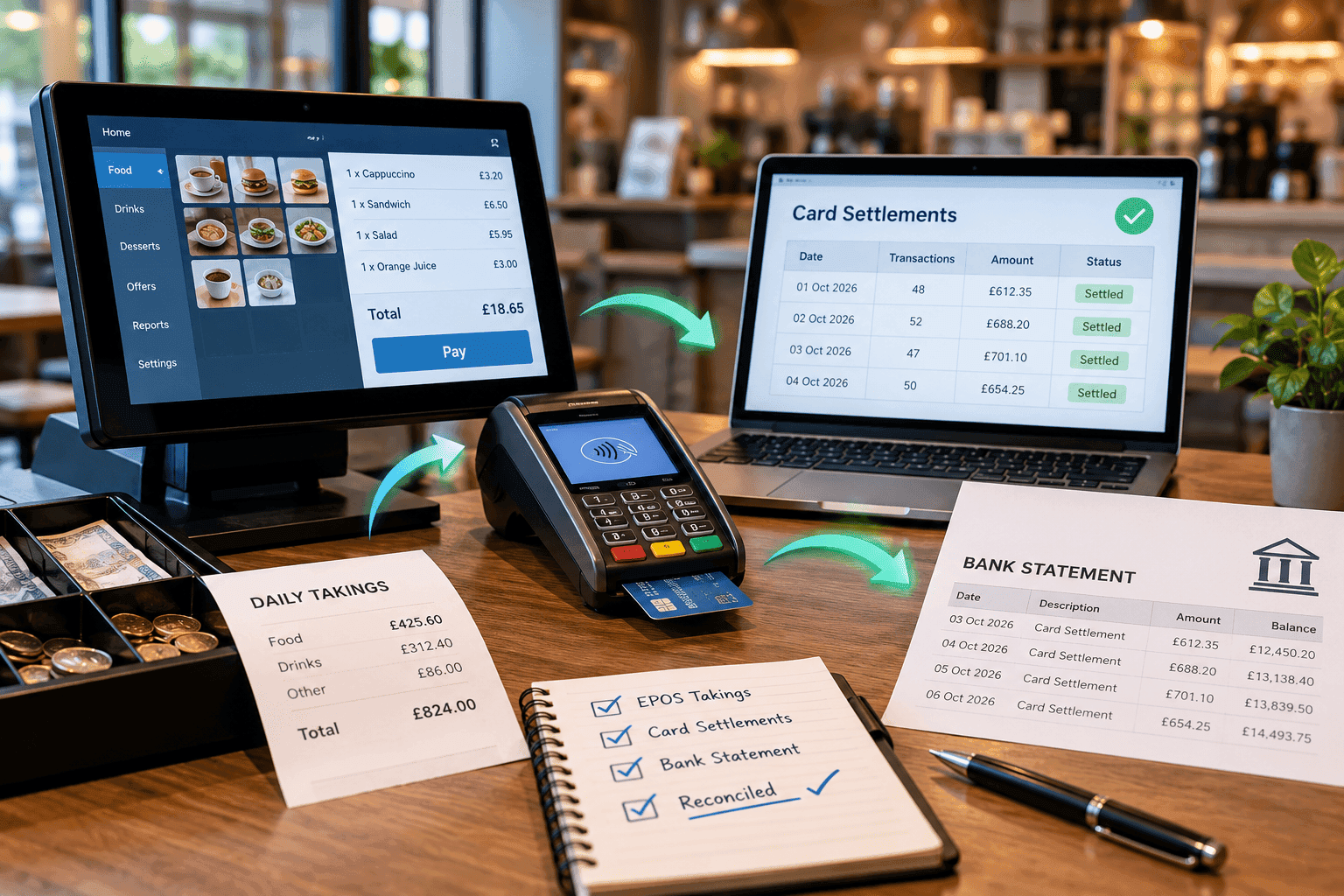
We reconcile EPOS takings for restaurants, pubs, cafés and hotels on behalf of the UK accountancy practices we support. The files that stay clean have one thing in common. They don’t try to match the Z report to the bank. They post a daily sales journal into clearing accounts, and each clearing account is proved against its own settlement report.
This guide walks through that method: why the figures never agree on the day, how the journal is built, and how to deal with card fees, tips, delivery payouts, cash, voids and refunds. It finishes with the daily and monthly checks that let you close a month with nothing left in suspense. It is written for practices with hospitality clients, and for operators who want to know what good POS reconciliation looks like, from restaurant POS reconciliation to hotel sales reconciliation across several revenue outlets.
Why daily takings never match the bank
The Z report records what was sold on a trading day. The bank statement records when money arrived and how much was left after deductions. Those are different questions, so the two totals will almost never agree on the same date.
Take a Saturday at a 90-cover restaurant. The Z report shows £6,840 of sales: £5,505 on card, £615 in cash, and £720 of Deliveroo orders. On top of that, guests added £286 of tips on the card terminal. Monday’s bank feed then shows £5,091.76 from the card acquirer. American Express pays £624 a few days later. The cash goes in on Tuesday, bundled with Sunday’s. The Deliveroo money arrives the following week, net of commission, inside a payout that covers seven days of orders. Nothing is missing, yet not one bank line matches a figure on the Z report.
These are the reconciling items we see on almost every hospitality file:
| Reconciling item | Why it happens | Where it belongs |
| Settlement timing | Acquirers settle in batches, so weekend takings often land on Monday or Tuesday | Card clearing account, cleared on the settlement date |
| Fees taken at source | On net settlement the bank receives takings less transaction fees | Merchant fees, posted gross in the ledger |
| American Express | Amex settles on its own timetable and fee basis | A separate Amex clearing account |
| Card tips | Tips sit inside the card batch but are owed to staff | Tips liability, cleared through payroll or the tronc |
| Delivery platforms | Paid weekly, net of commission, refunds and promotions | One clearing account per platform |
| Cash | Banked in bundles, after floats and paid-outs | Cash in transit (undeposited takings) |
| Deposits | Taken before the visit, often through a separate booking system | Customer deposits liability until the booking is fulfilled |
| Gift vouchers | Money comes in now; the sale happens later, or never | Voucher liability |
| Trading-day cut-off | The EPOS day may end at 3am while the terminal batch closes at midnight | Align the cut-offs, or reconcile by batch rather than calendar date |
When these items are coded straight from the bank feed to sales, each one becomes an error. Card fees vanish from the profit and loss account. Tips inflate turnover and the VAT return, even though freely given tips are outside the scope of VAT. Delivery income is booked net, so commission never appears as a cost. A bank rule that codes every card receipt to sales feels efficient, but it is how most suspense balances begin.
The daily sales journal structure
The daily sales journal is the bridge between the till and the bank. Post one journal per site for each trading day, taken from the Z report. Split the debits by where the money will come from, and the credits by what was sold and who is owed what.
The credit side records what the day earned and what it owes:
- Sales by category, net of VAT: food, drink, accommodation and other income.
- Output VAT, taken from the EPOS VAT analysis rather than worked back from the total.
- Card tips and discretionary service charge, credited to a tips liability account.
- Deposits taken and gift vouchers sold, credited to their own liability accounts.
The debit side records where the money will arrive from:
- One card clearing account per acquirer, with American Express kept separate.
- Cash in transit, using the cash actually counted, with any difference posted to a till variance account.
- One clearing account for each delivery platform.
- Deposits and vouchers redeemed that day, which reduce the liability.
- Trade debtors for invoiced functions and account customers.
Here is the journal for the Saturday in our example. All sales are standard-rated, and the fees used later are illustrative.
| Account | Debit (£) | Credit (£) |
| Card clearing: main acquirer | 5,151.00 | |
| Card clearing: American Express | 640.00 | |
| Cash in transit | 615.00 | |
| Deliveroo clearing | 720.00 | |
| Sales: food | 3,950.00 | |
| Sales: drink | 1,750.00 | |
| Output VAT | 1,140.00 | |
| Tips payable (tronc) | 286.00 | |
| Total | 7,126.00 | 7,126.00 |
As the money lands, each receipt clears its own account. Monday’s £5,091.76, plus £59.24 of fees, clears the £5,151.00 in the main acquirer account. Amex’s £624.00, plus its £16.00 fee, clears £640.00. Tuesday’s cash deposit clears cash in transit, together with Sunday’s takings. The Deliveroo payout clears its account once commission and adjustments are posted. Anything left on a clearing account after its settlement is a real difference, and it can be traced to a specific day.
Take VAT from the till, not from a fraction. A café selling eat-in meals, hot takeaway food and cold takeaway sandwiches is making standard-rated and zero-rated sales on the same Z report. HMRC’s catering notice (VAT Notice 709/1) sets out the hot food tests, and the EPOS product codes need to follow them. This year added one more trap. A temporary 5% rate applied to certain children’s meals from 25 June to 1 September 2026. If a client’s EPOS was reprogrammed for that window, check it was switched back afterwards, and that the reduced-rate sales on the VAT return agree to the Z reports for those dates.
Check the integration mapping before you trust it. Most cloud EPOS systems can push a daily summary into Xero or QuickBooks. That saves hours, but only if the mapping is right. On files we take over, we regularly find card tips mapped to sales, delivery orders counted twice, and card takings posted straight to the bank account rather than to a clearing account. One afternoon spent correcting the mapping saves a month-end of unpicking.
Card settlements and merchant fees
Card takings are the biggest number on most hospitality Z reports, so this is where hospitality payment reconciliation is won or lost. The rule is simple. Debit the card clearing account with what the terminals took. Credit it with what the acquirer paid, plus what it kept. The balance should come back to zero.
Gross or net settlement
Find out which one the client has before you reconcile anything. On net settlement, the acquirer deducts fees before paying out, so each receipt is smaller than the batch. Post the fee from the settlement report so that sales and fees both show gross. On gross settlement, the full batch is paid and the fees are collected later, usually by monthly direct debit with an invoice. In that case the clearing account clears daily and the fees need accruing at month-end. A surprising number of “unexplained” differences turn out to be a month of fees taken by direct debit on the 10th.
Matching by batch, not by date
Match each payment to the terminal batches it covers, using the acquirer’s settlement report rather than the bank narrative. Some acquirers pay every day, including weekends. Others combine Friday to Sunday into one Monday payment. Where a site has several merchant IDs, for example the bar and the restaurant, each may settle separately. Map every merchant ID to a site and a clearing account before the first month is processed.
If the terminals are not integrated with the EPOS, compare the EPOS card total with the terminal batch total every day. A £45.00 bill keyed as £54.00 on a standalone terminal shows up as a £9.00 difference that nobody can explain three weeks later.
American Express and other separate settlements
American Express usually settles directly, on its own timetable and fee basis, so it needs its own clearing account. The same goes for pay-at-table apps, QR ordering and booking platforms that take deposits through their own payment processor. Each source of money gets its own clearing account, and each is proved against its own report.
Fees and VAT
Merchant statements mix charges with different VAT treatment. HMRC’s VAT Finance Manual (VATFIN3160) lists merchant fees as exempt and terminal rental as standard-rated. So don’t post the whole statement to “bank charges” with a blanket VAT code. Split transaction charges from rental and service fees, and follow the VAT shown on the provider’s invoice.
Tips through the card terminal
Card tips arrive inside the settlement, but they are not income. Credit them to a tips liability on the day they are taken. Tips that are freely given are outside the scope of VAT, and so is a genuinely optional service charge. HMRC’s guidance (VATSC06130) confirms that a compulsory service charge is part of the price and follows the VAT liability of the meal.
The Employment (Allocation of Tips) Act 2023 requires all qualifying tips to reach workers without deductions. That means the business absorbs the card fees on tips. Tips must be paid out by the end of the month after the customer paid them, and records kept for three years. A further duty to consult staff on the tipping policy was expected this month, but has been postponed, with the government aiming for the end of 2026.
The National Insurance position depends on who decides the split. HMRC’s tronc guidance says that where a genuinely independent troncmaster decides, PAYE applies but no NICs are due. Where the employer decides, both apply.
One control catches most tips problems. The tips liability at month-end should broadly equal that month’s unpaid tips. If the balance at 31 October is larger than October’s tips, an earlier month has not been paid out, and the business may be in breach of the payment deadline.
Chargebacks and refunds
Chargebacks are deducted from settlements, sometimes weeks after the sale. Post them to a disputes account and track the outcome, rather than letting them reduce a random day’s card clearing. Card refunds processed on a later day reduce that day’s batch. Record the original receipt number with each refund, so the sale and the refund can be matched.
Delivery platform payouts
Delivery is where most suspense balances start, because each payout is a single net figure hiding half a dozen different things. Post every payout in full, every week, from the platform’s own statement.
A typical payout contains gross order value, the platform’s commission, other fees, customer refunds and missing-item claims, cancelled or remade orders, promotions the restaurant funded, and adjustments carried over from earlier weeks. Deliveroo, for example, calculates and pays weekly for orders completed Monday to Sunday of the previous week. Its invoice comes as a PDF summary and a CSV with every order, refund and rebate listed. Those invoices stay in Partner Hub for 12 months, so save them every month. VAT records have to be kept for much longer than that.
Posting the payout
The daily sales journals have already debited the Deliveroo clearing account with each day’s orders. Say the week’s orders total £4,860.00, including Saturday’s £720. The weekly invoice shows commission of £1,458.00 plus £291.60 VAT, and £37.50 of customer refunds. The payout is £3,072.90. The commission rate here is illustrative; rates vary by contract.
| Account | Debit (£) | Credit (£) |
| Bank | 3,072.90 | |
| Delivery commission (cost of sales) | 1,458.00 | |
| Input VAT | 291.60 | |
| Sales refunds | 31.25 | |
| Output VAT (refunds) | 6.25 | |
| Deliveroo clearing | 4,860.00 | |
| Total | 4,860.00 | 4,860.00 |
The clearing account goes back to zero, commission shows as a real cost in the profit and loss account, and VAT is right on both sides.
When the payout doesn’t clear the account
When there is a balance left, it usually comes from one of five places:
- Menu prices. Platform prices are often higher than in-store prices. If orders are rung through the till manually at in-store prices, sales are understated.
- Cancellations. Orders were accepted on the EPOS but later cancelled or remade on the platform.
- Timing. The platform week runs Monday to Sunday and rarely ends on the last day of the month. The final days’ orders sit in the clearing account at month-end as money due, which is correct.
- Prior-week adjustments. Refund claims and promotions can land on a later invoice than the order they relate to.
- Cash orders. Where the restaurant delivers and collects cash itself, that cash belongs in cash in transit, while the platform’s commission on those orders is deducted from the card payout.
VAT on delivery sales
The restaurant is still the supplier of the food. Output VAT is due on the menu price the customer paid for it, not on the payout, and the hot and cold rules still apply item by item. Check who issues the commission invoice. A UK VAT-registered platform charges UK VAT, which can be reclaimed with a valid invoice. An overseas entity means accounting for the reverse charge instead. Also check how each promotion is funded and invoiced before deciding whether it reduces sales or counts as a marketing cost.
Count delivery sales once. If the orders flow into the EPOS through an integration, the Z report already includes them. Posting the platform statement as sales as well doubles the turnover and the VAT. Pick one source for the sale, and use the other only to clear the account.
Cash, tills and variances
Cash is a smaller share of takings than it used to be. That is exactly why it gets less attention, and why its differences so often go unexplained.
The cash-up
Every till should be cashed up at the end of each trading day, on a sheet that records five figures: the float kept back, the cash counted, paid-outs (with receipts), the cash the Z report expected, and the variance. A blind cash-up, where staff count the drawer before they see the expected figure, gives a more honest count. Keep the sheet with the Z report. Together they are usually among the first records asked for in an HMRC compliance check of a cash business.
Watch for days when nobody ran the Z report. The next day’s Z then covers two trading days, the daily journal doubles up, and the cash-up no longer lines up with either day.
Floats and paid-outs
The float is not takings. Keep it at a fixed amount per till and record any change to it. Paid-outs are small purchases paid straight from the drawer: the emergency milk run, the window cleaner, a delivery tip. Each one reduces the cash banked, so each needs a receipt and an expense code. Without a paid-out record, every one of them turns into a cash shortage.
Banking
Debit cash in transit with the cash actually counted each day, and credit it when the money is banked. Most sites bank several days together, so write the deposit slip or bag number on each cash-up sheet. That lets one bank line be matched to the days it covers. If the bank’s count differs from the site’s count, the bank’s figure stands, and the difference goes to till variance with a note.
Tolerances and what to investigate
Small differences are normal. Set a tolerance per till per day, for example £5, and review the running total every month. A £2.40 shortage on a Tuesday isn’t worth an hour of anyone’s time. Six £20 shortages on Friday nights, on the same till, are worth a conversation.
Overs deserve as much attention as shorts. A drawer that is regularly over often means cash tips are going into the till, or sales are being rung up after the cash has been taken. Cash tips also need a clear route. Tips that staff keep personally fall outside the tipping rules, but cash tips that the business collects and shares out at the end of a shift are likely to be caught by them. Those need recording in the tips liability, not the till.
Voids, refunds and staff discounts
Voids, refunds and discounts rarely cause a bank difference, because the money never arrived in the first place. They show up as missing margin instead, and occasionally as missing cash. That’s why they need their own review, separate from the bank reconciliation.
Voids
A void before the order reaches the kitchen is usually a simple correction. A void after the kitchen has the ticket is different: food has been made, so it is either waste or a lost sale. It is also the classic pattern behind till fraud, where a cash bill is voided after the customer has paid and the cash leaves with someone. Require a manager’s authorisation and a reason code for post-send voids, and review the void report each week by staff member and shift. The Z report shows sales after voids, so voids never appear in the ledger unless someone goes looking.
Refunds
Refund to the original payment method wherever possible. A card refund reduces the card batch on the day it is processed, which is often a different day from the sale. A cash refund comes out of the drawer and belongs on a refund log with the original receipt number. Delivery refunds arrive through the platform invoice. In every case, post the refund as a reduction in sales and output VAT from the EPOS refund report, not as an expense. A cash refund against a card sale should always be questioned.
Discounts and comps
Discounts reduce the selling price, and VAT is due only on what the customer actually pays. Comps need more care, because the VAT treatment depends on who received them. HMRC’s catering notice (VAT Notice 709/1) treats free meals or drinks for customers or friends as business entertainment, so the VAT on the costs can’t be reclaimed. A free dessert or liqueur given to a table that is paying for its meal is different, because it forms part of a taxable supply. Give comps, discounts and staff meals separate reason codes on the EPOS so the treatment can be checked.
Staff meals and staff discounts
Under the same notice, catering provided free to employees carries no VAT. Where staff pay, even at a discount, VAT is due on what they pay. HMRC’s hotel notice (VAT Notice 709/3) adds that this includes meals paid for out of salary, such as under salary sacrifice. Proprietors’ and family meals are not treated as catering, but VAT is still due on the cost of standard-rated stock they take, such as soft drinks, alcohol and crisps.
Warning signs worth a closer look
- Post-send voids that keep rising, or cluster on one person or shift.
- Frequent “no sale” drawer openings.
- Cash refunds against card sales.
- Discounts applied after the bill has been printed, or late in the evening.
- Comps and staff meals with no reason code.
Daily and monthly controls
A clean month-end is the sum of thirty small daily checks, which is why hospitality daily sales reconciliation matters more than any month-end routine. When the daily ones are done, the month-end reconciliation takes an afternoon rather than a week.
| When | Check | What good looks like |
| Daily | Z report run and saved for every till | One Z per till per trading day, numbered in sequence |
| Daily | EPOS card total against terminal batch total | Agrees to the penny, or the difference is explained the same day |
| Daily | Cash-up sheet completed | Variance within tolerance, every paid-out receipted |
| Daily | Sales journal posted | Posted by the next working day; journal total equals the Z total plus tips |
| Weekly | Card settlements matched | Each card clearing account holds only batches not yet settled |
| Weekly | Delivery invoices posted | One payout per platform per week; clearing holds only unpaid orders |
| Weekly | Void, refund and discount reports reviewed | Exceptions raised with the site manager |
| Monthly | Every clearing account | Balance equals a list of named items still in transit |
| Monthly | Merchant fees | Settlement reports and monthly invoices agree to the ledger, with the VAT split correctly |
| Monthly | Tips liability | Equals this month’s unpaid tips; last month’s paid by its deadline |
| Monthly | Deposits and gift vouchers | Liability agrees to the booking system and the voucher register |
| Monthly | Output VAT | Ledger agrees to the EPOS VAT reports for the period, rate by rate |
| Monthly | Suspense | Nil |
Closing the month with nothing in suspense
The test for every clearing account is simple: can you list what makes up its balance? “Card clearing £5,804.12, being the batches for 30 and 31 October, settled on 1 and 2 November” is a timing difference. “Card clearing £5,804.12, cause unknown” is not, however many months it has been rolled forward. If a balance can’t be listed, it isn’t timing, and it needs investigating before the month is closed.
Clearing an old suspense balance
October and November are the right time to do this, before December trading buries the problem under the busiest weeks of the year. This is the order we work in:
- Freeze it. Stop posting anything new to suspense, and set up the clearing accounts so that this month’s transactions follow the method above.
- Age it. Split the balance by month and by likely source: card, cash, delivery or unknown.
- Rebuild the big sources first. Download the acquirer settlement reports and delivery platform CSVs for the period, and post the missing fees, commission and refunds. Do this while the platform portals still hold the history.
- Match what’s left to specific days. Compare daily Z totals with banking. A residue on particular days usually points to a missing Z report, a double posting or a genuine cash shortage.
- Agree a write-off limit for the remainder. Agree the threshold with the client and the reviewing manager, document it, and post it with a clear narrative. Never post it to sales.
- Fix the VAT. If the clean-up shows tips posted to sales or delivery income booked net, earlier VAT returns are wrong. HMRC’s VAT Notice 700/45 allows net errors of up to £10,000, or up to £50,000 where they are no more than 1% of box 6, to be corrected on the next return. Larger errors must be notified separately. Even within those limits, HMRC expects a separate disclosure of careless errors if the business wants the maximum penalty reduction.
Putting it into practice
EPOS reconciliation isn’t difficult. It is repetitive, it has to happen every trading day, and it falls apart the moment someone takes a shortcut. Post one journal per trading day. Give every source of money its own clearing account. Prove each one against its own report, and treat any balance you can’t list as a problem to solve, not a number to carry forward. Do that, and the hospitality bank reconciliation becomes the easy part.
For practices, this is work that moves well to an outsourced team, and it is usually the first thing firms hand over when they look at outsourced bookkeeping for hospitality clients. The method is the same on every file, exceptions can be flagged for a manager to decide, and the client only sees the reviewed result. Our POS reconciliation services cover hospitality sales reconciliation from end to end: the daily sales journals, card and delivery clearing, cash and till variances, the tips liability and the month-end pack, all prepared inside your own Xero, QuickBooks or Sage files.
You can see how we support restaurants, pubs, cafés and hotels on our Hospitality page, or see how our outsourced bookkeeping fits into your review process. For the wider month-end, read Hospitality Bookkeeping: The Monthly Close, Step by Step. Hotel clients add another layer, with night audit, the city ledger and advance deposits, which our guide to hotel accounting services covers. The VAT side is covered in our hospitality VAT guide, and the returns themselves go through our VAT services. Tips and tronc payments run through our payroll service.
Frequently Asked Questions
General
What is POS reconciliation?
POS reconciliation is the check that what the till says was sold matches what was actually received, payment type by payment type, once fees, tips, refunds and timing are taken into account. In hospitality it covers card settlements, cash banking, delivery platform payouts, deposits, and vouchers. Done properly, it ends with every clearing account explained and nothing in suspense.
How do you reconcile EPOS takings to the bank?
Don’t match the Z report to the bank directly. Post a daily sales journal that debits a clearing account for each payment source and credits sales, VAT and tips. Then clear each account as the money arrives, using the acquirer’s settlement report, the cash banking record and the platform invoices. Practitioners on AccountingWEB describe the same approach, often calling it a takings control account.
Why don’t my card machine deposits match my daily sales?
Usually for four reasons: the acquirer settles a day or more later, fees are deducted before payment, tips are included in the deposit, and weekend batches are combined. American Express and some app payments settle separately too. A thread on AccountingWEB about pub accounts adds one that catches many venues out: a terminal batch that closes at a fixed time, such as 9pm, while the bar is still trading.
What is a Z report, and how is it different from an X report?
An X report is a snapshot of the day so far and can be run as often as you like. A Z report closes the trading day, resets the totals and is the one used for the accounts. Keep every Z report, because it forms part of the business’s VAT records.
How often should a restaurant or pub reconcile its takings?
Check cash and card totals against the Z report every trading day, card settlements and delivery invoices every week, and every clearing account at month-end. Daily checks catch keying errors and cash shortages while staff still remember the shift. Leaving everything to month-end turns a ten-minute question into a half-day investigation.
Should sales be imported from the EPOS integration or posted from the Z report?
Either can work, provided the mapping is checked first. One practitioner on AccountingWEB warns that a direct import brings in every till operator’s mistakes, such as card payments rung in as cash. Our approach is to use the integration for speed, then reconcile the imported totals to the cash-up sheet and terminal batch report before the day is closed.
Card payments, fees and tips
How long do card payments take to reach the bank?
It depends on the acquirer and the contract. Many pay the next working day, some pay every day including weekends, and others combine weekend batches into Monday. American Express usually settles separately, on its own timetable. The settlement report, not the bank narrative, tells you which batches each payment covers.
Is there VAT on card machine fees?
Usually only on part of the statement. HMRC’s VAT Finance Manual treats merchant fees as exempt and terminal rental as standard-rated. Follow the VAT shown on the provider’s invoice, and keep exempt charges and VAT-able fees on separate lines.
Are tips subject to VAT?
Not if they are freely given. A tip on top of the bill, and a service charge the customer can genuinely choose not to pay, are both outside the scope of VAT. A compulsory service charge is part of the price of the meal and is taxed with it, as HMRC’s manual (VATSC06130) explains.
Can a business deduct card processing fees from staff tips?
No. Since 1 October 2024, the Employment (Allocation of Tips) Act 2023 has required qualifying tips to be passed to workers without deductions, other than tax. The cost of processing tips paid by card stays with the business.
Do card tips have to go through payroll?
Tips are taxable, so PAYE income tax applies when they are paid to employees. National Insurance depends on who decides the allocation. HMRC’s tronc guidance says no NICs are due where an independent troncmaster decides how the money is divided, but they are due where the employer decides.
Is a discretionary service charge treated as a tip?
For VAT, yes: a service charge the customer can genuinely refuse sits outside the scope of VAT, just like a tip. It is also covered by the tipping rules, so it must reach staff in full. A compulsory service charge is different, because VAT is due on it, so check how the charge is presented on the menu before deciding the treatment.
Delivery platforms
Should Deliveroo, Uber Eats and Just Eat sales be recorded gross or net?
Gross. The restaurant sold the food at the menu price, so that is the sale, and the platform’s commission is a cost. A practitioner on AccountingWEB sets out the entries: debit the platform account with total sales, credit sales and VAT, then clear the platform account with the bank receipt and the commission invoice. Recording the payout as the sale understates turnover and output VAT.
How do I work out the VAT on delivery sales when some items are zero-rated?
Use order-level data, not a flat fraction of the payout. It is a common question on UK Business Forums, where an owner with cold items on the menu asked how to split the VAT. If orders flow into the EPOS, its VAT report already splits them by product. If they don’t, map the platform’s item-level CSV to the same VAT codes the till uses.
Can I claim the platform’s commission as an expense?
Yes. Commission and platform fees are business costs, and the VAT on them can be reclaimed with a valid VAT invoice from a UK-registered platform. What you can’t do is reduce sales by the commission. As one AccountingWEB reply explains, sales of 120 with fees of 20 means declaring 120 of sales and 20 of costs, not 100 of sales.
Why is my Deliveroo payout different from the orders on my EPOS?
Usually because of commission, refunds, cancelled or remade orders, restaurant-funded vouchers and adjustments from earlier weeks. Deliveroo’s invoice breakdown lists each of these order by order. Higher platform menu prices, and orders keyed manually at in-store prices, are the other usual causes.
Cash and tills
What is an acceptable till variance?
There is no official figure. Most operators set a small tolerance per till per day and review the running monthly total by till and shift. Patterns matter more than single days: repeated shortages on the same shift, or a drawer that is regularly over, are worth looking into.
How should cash tips be recorded?
It depends on who controls them. Cash tips that staff keep personally stay outside the business’s records. Cash tips that the business collects and shares out are qualifying tips, so record them in the tips liability, pay them through the tronc or payroll, and keep the allocation records for three years.
What happens if a Z report wasn’t run?
The next Z report will cover two trading days. Post one journal for both days, note it on the cash-up sheet, and expect the cash and card checks for those days to be combined. If it happens often, set the EPOS to prompt for, or force, an end-of-day close.
Month-end, VAT and records
What is the difference between a clearing account and a suspense account?
A clearing account holds a known item for a short time, such as card takings waiting to settle, and its balance can always be listed. A suspense account holds items nobody has identified yet. Clearing accounts are a normal part of hospitality bookkeeping. A growing suspense balance is a sign the reconciliation has stopped working.
How do I clear a suspense balance that has built up over months?
Freeze it, age it, then rebuild the largest sources first from settlement reports and platform invoices. Match what remains to specific days, and agree a documented write-off limit for any small remainder. If the work uncovers VAT errors, correct them under VAT Notice 700/45.
How long should Z reports and settlement reports be kept?
Treat them as VAT records and keep them for at least six years, as HMRC’s record keeping notice (VAT Notice 700/21) requires. Download delivery platform invoices regularly, because portals may only hold the last 12 months. Tip allocation records must be kept for three years under the tipping rules.
What do outsourced POS reconciliation services include?
With us, the service covers the daily sales journals, card, Amex and delivery clearing, cash and till variances, the tips liability, deposits and vouchers. Each month ends with a pack showing every clearing account explained. The work is done inside your client’s own accounting software and reviewed before you see it.
How much does outsourced hospitality bookkeeping cost?
It depends on the number of sites, the EPOS and transaction volumes, payroll headcount and whether a tronc is running. We price per client and per workflow rather than quoting a headline rate. Our Hospitality page explains how we price, and a free trial on one real client is the quickest way to a firm figure.
Cleaning up hospitality files before the Christmas rush?
We prepare daily sales journals, card and delivery reconciliations, tips liability schedules and month-end packs for UK accountancy practices with restaurant, pub, café and hotel clients. Every file comes back ready for your review. Start with a free trial. No commitment required.
Start Free Trial · Talk to Our Team
Sources and further reading
- HMRC: Catering, takeaway food (VAT Notice 709/1)
- HMRC: Revenue and Customs Brief 5 (2026), temporary reduced rate for children’s meals
- HMRC VAT Supply and Consideration Manual, VATSC06130: tips and service charges
- HMRC VAT Finance Manual, VATFIN3160: card services
- GOV.UK: Distributing tips fairly, statutory code of practice
- GOV.UK: Employee gets tips, gratuities or service charges through a tronc
- HMRC: How to correct VAT errors (VAT Notice 700/45)
- Lewis Silkin: Top tips to get ahead of the upcoming tipping changes (August 2026)
- Deliveroo Help Centre: How invoices and payments work
This article is general guidance on UK bookkeeping, VAT and tipping rules as at October 2026. It is not advice on any individual business’s circumstances.
Need help outsourcing this to a specialist team?
We handle bookkeeping, VAT, payroll, and year end accounts for UK accounting firms from India. Start with a free trial. No commitment required.