Bookkeeping outsourcing UK explained: how it compares to hiring in-house on cost, compliance and scale, so your accountancy practice can pick the right model.

Table of Contents
Bookkeeping outsourcing in the UK has gone from a fringe option to a serious strategic choice for accountancy practices. If you run a firm, you’ve probably had this argument with yourself more than once: hire bookkeepers and grow a team you control, or hand the work to an outside provider and buy capacity instead?
It’s got louder lately. MTD for Income Tax starts biting from April 2026, client volumes keep climbing, and good bookkeepers are hard to find and harder to keep. So the decision carries more weight than it did a few years ago.
There isn’t a clean answer, and anyone who gives you one is probably selling something. What’s right for you depends on your client mix, how fast you want to grow, how much management hassle you can stomach, and where you want the firm to be in five years. Here’s how the two models stack up.
The short version
Hire in-house if bookkeeping is part of what clients actually pay you for, they like seeing the same faces, and you’ve got the headspace to recruit and train.
Choose bookkeeping outsourcing if you need capacity quickly, your workload spikes hard around quarter-ends, or you want senior people off low-margin processing.
Most growing firms end up doing a bit of both, though. A small in-house core for the tricky clients and an outsourced team for the volume. I’ll come back to that.
What each option really means
In-house means employees on your payroll. Usually some juniors, an AAT-qualified bookkeeper or two, and someone senior who reviews and signs off. You own the training, the software, the hours. You also pay for all of it: salary, employer’s NI, pension, holiday, sick pay, kit, licences, and your own time managing people.
Bookkeeping outsourcing is broader than people assume. It runs from a UK firm doing work under your brand, to an offshore provider in India, the Philippines or South Africa, to the “dedicated team member” setup where you basically rent a full-time bookkeeper who only touches your clients. The common thread is that you’re buying output rather than hiring a person, and responsibility for the work stays with you because you’re the regulated firm.
What bookkeeping outsourcing actually costs vs hiring in-house
Cost is usually what gets people looking at outsourcing in the first place. The trap is comparing a salary to an invoice, because the salary is only half the real number.
Here’s roughly what an in-house bookkeeper costs over a year. Treat these as planning figures, not gospel:
| What you pay for | Typical annual cost |
|---|---|
| Salary (AAT-qualified) | £26,000 – £35,000 |
| Employer’s NI | ~£2,500 – £3,800 |
| Pension (auto-enrolment) | ~£800 – £1,100 |
| Software, hardware, desk | £1,500 – £3,000 |
| Recruitment and onboarding | £1,000 – £2,500 |
| Training and CPD | £500 – £1,500 |
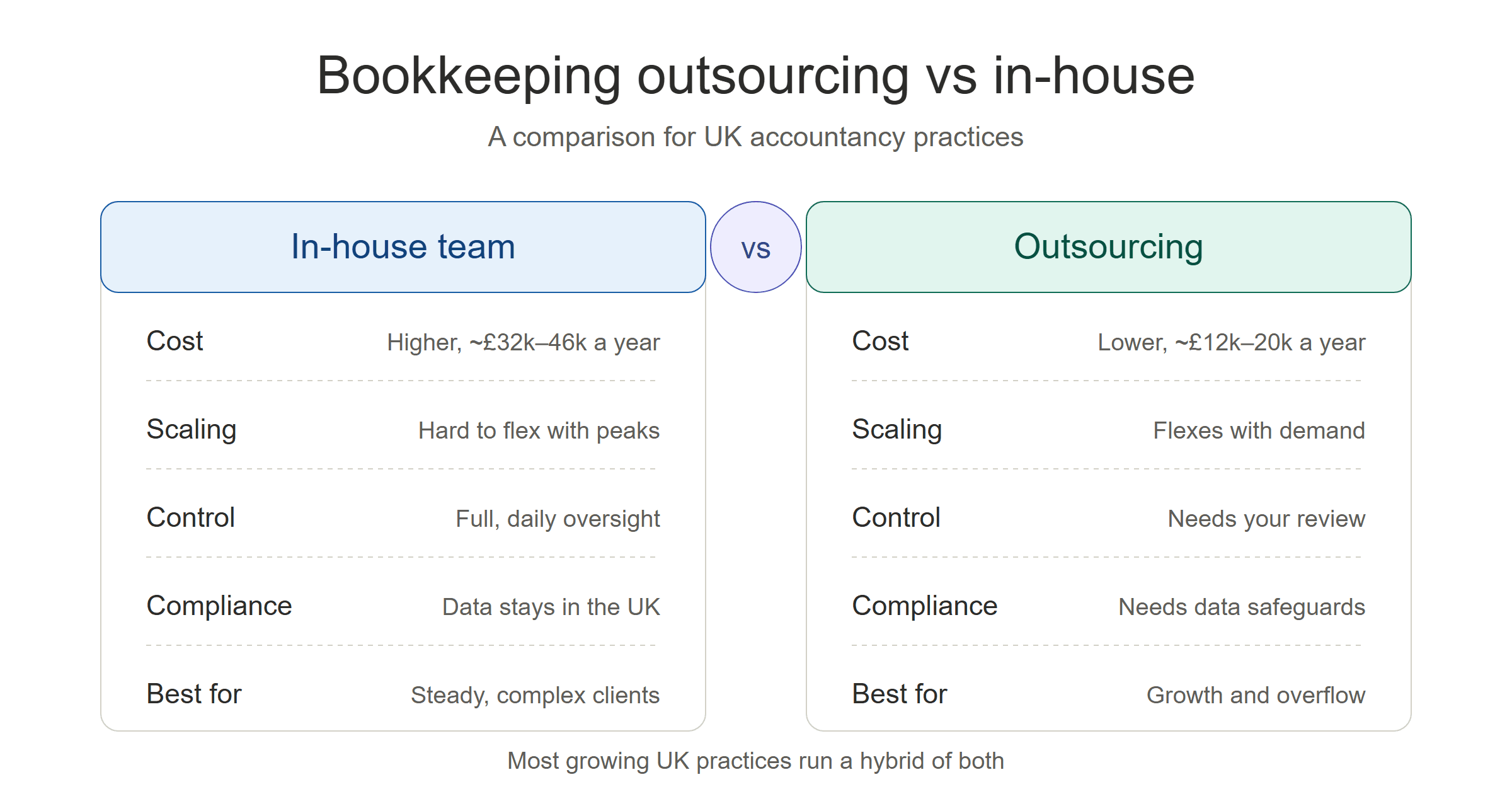
| Real total | ~£32,000 – £46,000 |
Then there’s the stuff that never makes it onto a spreadsheet: covering holidays and sick days, the gap when someone hands in their notice, and the few months a new hire needs before they’re actually pulling their weight.
Bookkeeping outsourcing usually lands lower. An offshore full-time equivalent runs somewhere around £12,000 to £20,000 a year. Onshore providers tend to charge per job, per hour (£15–£30 and up), or on a monthly retainer.
Don’t fall in love with the headline gap, though. A cheap offshore hour that needs heavy reviewing on your side eats into the saving quickly. The number worth chasing is cost per finished, reviewed job. Work that out before you decide anything, because it changes the picture more often than people expect.
Quality and keeping control
In-house has obvious upsides. You see the work daily and can fix things on the spot. Your people learn how your firm does things and how it talks to clients. And a bookkeeper who’s been with you for years knows your clients in a way that’s genuinely hard to write down, let alone hand over.
Outsourcing can hit the same quality bar, but it asks more of you up front. It works best when your processes are written down and consistent. If your firm quietly runs on “we just know how to do it,” the handover will hurt. Review also stays your job. Even with a strong provider, someone UK-qualified should sign off, so outsourcing tends to move the bottleneck from doing the work to checking it. On the upside, the time difference can work for you: send something at 5pm and it’s often back by morning.
So the honest comparison isn’t in-house versus outsourced in the abstract. It’s well-run versus badly-run. A sloppy version of either will lose to a tidy version of the other.
Scaling up and down
This is where outsourcing tends to win comfortably.
UK bookkeeping demand is lumpy. VAT quarters, the January Self Assessment crush, year-end clusters, and now quarterly MTD updates. Build an in-house team big enough for the peak and you pay for idle people in the quiet months. Build for the average and your team is drowning in January while clients wait.
Outsourcing flexes with that. You scale up for the busy run and back down after, usually without redundancy costs. If you’re growing fast and signing clients quicker than you can hire, it’s often the only way to stop service slipping. If you’re a settled practice with steady, predictable work, an in-house team can be cheaper and simpler to run.
The compliance bit you can’t skip
Read this part twice, because this is where UK bookkeeping outsourcing trips people up.
UK GDPR and sending data abroad. Outsource outside the UK and you’re transferring personal data internationally. You need a lawful mechanism for it, usually the International Data Transfer Agreement or the UK Addendum to the EU SCCs. You need a transfer risk assessment. And your engagement letters and privacy notices need to say that third parties, possibly offshore, may process client data. The ICO’s guidance on international transfers is the place to start.
Anti-money laundering. Outsourcing the bookkeeping doesn’t outsource your AML duties. You’re still the supervised firm, and client due diligence stays with you.
Your professional body. ICAEW, ACCA, AAT and CIMA all publish guidance on outsourcing and subcontracting. The common thread: you stay responsible for the work, you keep proper oversight, and you tell clients where it’s relevant. Check what yours says specifically.
Telling clients. Plenty of UK clients are fine with outsourcing. Some aren’t, especially about data going offshore. Far better to put it in your terms up front than to have that conversation after they’ve found out some other way.
Security. Onshore or offshore, check the provider’s controls. ISO 27001, scoped access to your cloud accounting stack rather than shared master passwords, proper audit trails. Xero, QuickBooks, FreeAgent and Sage all let you grant limited access instead of handing over the keys, so use that.
How the risks compare
| Risk | In-house | Outsourced |
|---|---|---|
| Losing a key person | High, resignations sting | Lower, the provider absorbs it |
| Recruitment in a tight market | High | Shifted to the provider |
| GDPR / data protection | Stays in the UK | Needs transfer safeguards |
| Consistent quality | Down to your training | Provider plus your review |
| Predictable cost | Fixed, but high | Variable, usually lower |
| Business continuity | You own it | Provider dependency, exit risk |
One risk people forget on the outsourcing side: what happens if the provider underperforms or shuts down? Can you get your data, documentation and workflows back cleanly? Sort out an exit clause and data-portability terms when you sign, not when it’s already going wrong.
Is bookkeeping outsourcing right for your UK practice?
The “outsource or in-house” framing rarely survives contact with a real, growing practice. What tends to win is a deliberate mix.
In-house keeps the complex clients, the advisory-adjacent work, the high-touch relationships, and the final sign-off. Outsourcing takes the volume: bank recs, data entry, the transactional grind, and the seasonal overflow. That protects the work that justifies your fees while pushing the commoditised stuff to a cheaper, more flexible channel. It also means you’re not completely exposed to a hiring drought, and not completely dependent on one outside provider either.
A few questions worth sitting with before you commit. What is bookkeeping worth to your brand: a loss-leader that feeds advisory work, or a paid service in its own right? How predictable is your workload, really? Have you got the management capacity, given outsourcing needs documented processes and review discipline while in-house needs you to recruit and manage people? And how will your clients feel about offshore data handling, since that shapes onshore versus offshore?
Underneath all of it sits one number: your real, fully-loaded cost per finished job. Not per hour. Our bookkeeping services team can help you work that number out.
Where this leaves you
For a UK practice, this was never really about cost on its own. It’s about control, flexibility, and how you want to handle growth.
In-house buys control, continuity and brand fit, at a higher fixed cost and with real recruitment risk in today’s market. Bookkeeping outsourcing buys flexibility and a lower per-job cost, as long as you keep reviewing the work properly and stay on the right side of UK GDPR, AML and your professional body.
For most firms that are actually growing, it isn’t one or the other. It’s a hybrid you’ve put together on purpose: judgment and relationships in-house, volume through a partner you trust. Work out your true cost per job, map where your year actually spikes, and check the compliance side honestly. The mix tends to pick itself once you’ve done that.
FAQ
Can UK accountants legally outsource bookkeeping?
Yes. The professional body rules allow it. But your firm stays responsible for the work, for AML, and for meeting UK GDPR rules on any data you send abroad.
Do I have to tell clients I’m outsourcing?
Put it in your engagement letter and privacy notice, especially if data goes offshore. It protects both the relationship and your compliance position.
Is offshore bookkeeping outsourcing safe?
It can be, if the provider has solid security (ISO 27001 is a good sign), you use scoped cloud access instead of shared logins, and you’ve got a valid international transfer mechanism in place.
Is bookkeeping outsourcing cheaper than hiring in the UK?
Usually, on a per-job basis. But compare fully-loaded cost per finished job, not the headline salary against the headline rate.
Need help outsourcing this to a specialist team?
We handle bookkeeping, VAT, payroll, and year end accounts for UK accounting firms from India. Start with a free trial. No commitment required.