Table of Contents
Making Tax Digital (MTD) for Income Tax: Everything UK Businesses Need to Know
The UK tax system is undergoing one of its biggest digital transformations through Making Tax Digital (MTD). Introduced by HMRC, this initiative is designed to modernise tax reporting by replacing manual record-keeping with secure digital systems.
Whether you’re a sole trader, landlord, accountant, or accounting practice, understanding Making Tax Digital for Income Tax is essential for staying compliant and avoiding penalties.
In this guide, we’ll explain how Making Tax Digital for Income Tax works, who it applies to, digital record-keeping requirements, and how Probal Global supports UK accounting firms with reliable outsourced accounting solutions.
What is Making Tax Digital (MTD)?
Making Tax Digital is an HMRC initiative that requires taxpayers to maintain digital financial records and submit tax information using compatible software instead of traditional paper records or manual submissions.
The primary objective of Making Tax Digital is to:
- Improve tax accuracy
- Reduce reporting errors
- Simplify tax administration
- Create a more efficient digital tax system
- Increase transparency between taxpayers and HMRC
Today, HMRC Making Tax Digital continues to expand across VAT and Income Tax, making digital compliance an important priority for UK businesses.
What is Making Tax Digital for Income Tax?
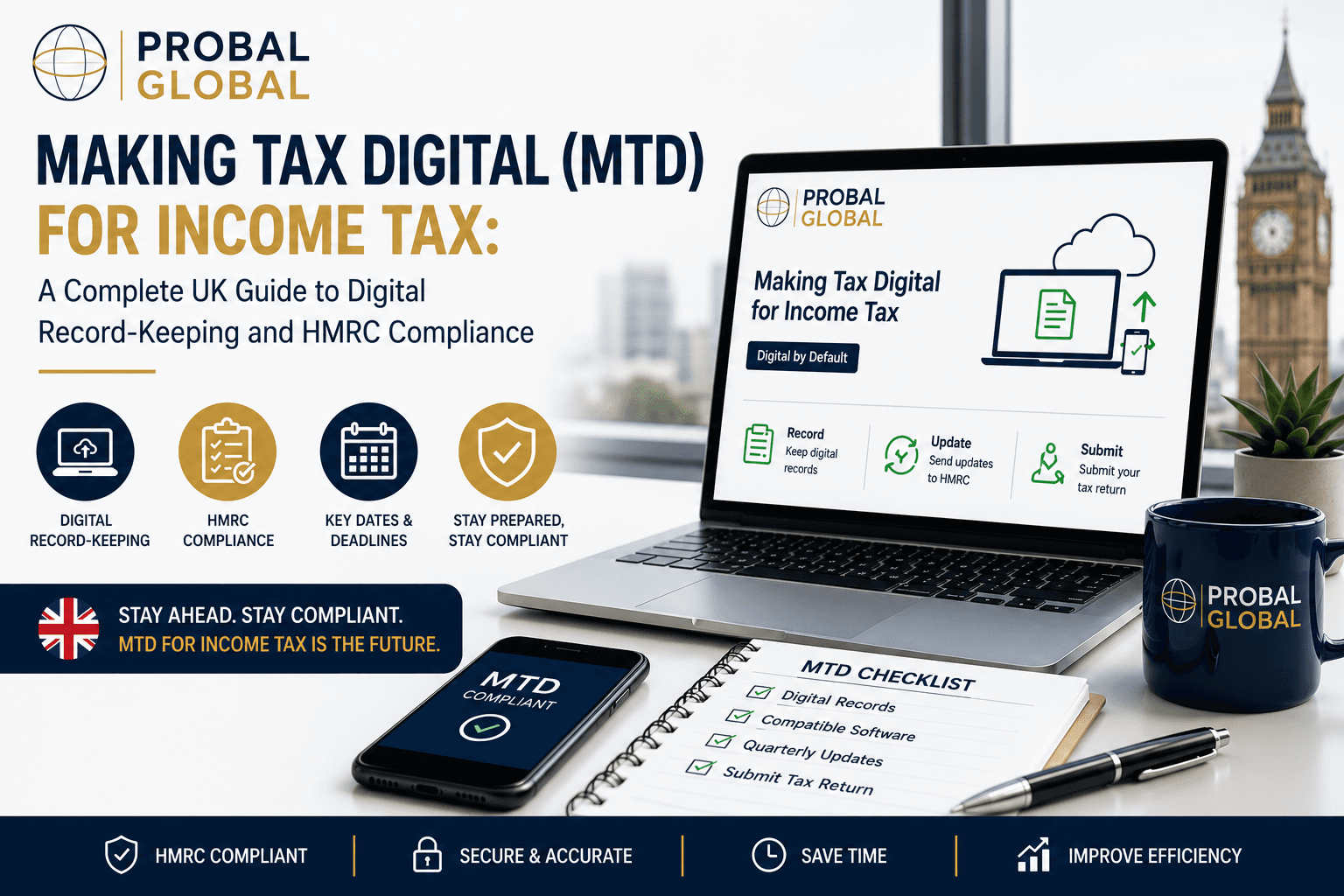
Making Tax Digital for Income Tax (also known as Making Tax Digital for ITSA) is the next phase of HMRC’s digital tax programme.
Instead of filing one annual Self Assessment tax return, eligible taxpayers will:
- Keep digital financial records
- Use MTD-compatible accounting software
- Submit quarterly updates to HMRC
- Submit a final declaration each tax year
This system gives taxpayers a more accurate picture of their tax position throughout the year.
What is MTD for Income Tax?
MTD for Income Tax applies primarily to:
- Sole traders
- Self-employed individuals
- Landlords with qualifying income
Those meeting HMRC’s income thresholds must comply with digital record-keeping and quarterly reporting requirements.
The purpose is to improve tax accuracy while reducing administrative errors.
MTD Income Tax Explained
Many UK businesses search for MTD Income Tax because they want to understand how it differs from the existing Self Assessment process.
Key differences include:
| Current Self Assessment | MTD Income Tax |
| Annual tax return | Quarterly submissions |
| Manual records allowed | Digital records required |
| Spreadsheet-based filing | Compatible software required |
| One annual submission | Quarterly updates + final declaration |
This change encourages better financial management throughout the year.
HMRC Making Tax Digital Requirements
Under HMRC Making Tax Digital, businesses must:
- Keep digital accounting records
- Use HMRC-recognised software
- Submit quarterly income updates
- Maintain accurate bookkeeping
- Complete a final end-of-period statement
Following these requirements helps businesses achieve full MTD compliance.
HMRC MTD Digital Record-Keeping Rules
One of the most important parts of HMRC MTD is digital record-keeping.
Businesses should digitally maintain:
- Income
- Business expenses
- Property income
- Sales invoices
- Purchase invoices
- VAT information (where applicable)
- Tax adjustments
Proper HMRC digital record keeping reduces mistakes and makes audits much easier.
Making Tax Digital UK: Why It Matters
The shift toward Making Tax Digital UK offers several advantages:
Improved Accuracy
Digital records minimise manual errors.
Faster Tax Reporting
Cloud accounting software automates many bookkeeping tasks.
Better Financial Visibility
Quarterly reporting gives businesses real-time insights into tax obligations.
Easier Compliance
Businesses remain aligned with evolving HMRC requirements.
Reduced Paperwork
Digital systems eliminate much of the traditional paperwork involved in tax filing.
Making Tax Digital for ITSA
Making Tax Digital for ITSA (Income Tax Self Assessment) introduces regular reporting throughout the financial year.
Instead of preparing everything once annually, businesses submit updates every quarter and complete a final declaration after the tax year ends.
This provides:
- Better tax forecasting
- Improved cash flow planning
- Reduced year-end workload
- Greater reporting accuracy
MTD for Self Assessment
Many taxpayers wonder whether MTD for Self Assessment replaces the existing system.
Rather than eliminating Self Assessment completely, MTD changes how information is submitted.
Businesses still complete an annual declaration, but the supporting financial data is submitted throughout the year using approved software.
Benefits of MTD Compliance
Achieving strong MTD compliance provides several long-term advantages.
Lower Risk of Errors
Digital bookkeeping significantly reduces calculation mistakes.
Better Business Decisions
Accurate financial records support informed decision-making.
Improved Productivity
Automation reduces repetitive accounting tasks.
Greater HMRC Compliance
Businesses following digital reporting standards are better prepared for regulatory changes.
Increased Client Confidence
Accounting firms offering MTD-ready services build stronger relationships with clients.
HMRC Compliance Best Practices
Maintaining HMRC compliance involves more than simply filing returns.
Best practices include:
- Keep records updated regularly
- Reconcile accounts monthly
- Use HMRC-approved accounting software
- Store supporting documents digitally
- Review quarterly submissions before filing
- Work with experienced accounting professionals
Common Challenges Businesses Face
Although MTD offers many benefits, businesses often face challenges such as:
- Transitioning from spreadsheets
- Staff training
- Software implementation
- Maintaining accurate digital records
- Meeting quarterly deadlines
- Managing multiple clients
Working with experienced accounting professionals helps overcome these challenges efficiently.
How Probal Global Supports UK Accounting Firms
At Probal Global, we specialise in providing outsourced accounting and bookkeeping support for UK accounting firms, accountants, bookkeepers, and financial service providers.
Our experienced team understands UK accounting standards, HMRC processes, and digital bookkeeping requirements, helping firms streamline operations while maintaining compliance.
Our Accounting Outsourcing Services Include
- Bookkeeping support
- Payroll processing
- VAT return assistance
- Year-end accounts preparation
- Management accounts
- Bank reconciliations
- Accounts payable & receivable
- Cloud accounting support
- Xero bookkeeping
- QuickBooks bookkeeping
- Sage accounting support
- Digital bookkeeping for HMRC reporting
By partnering with Probal Global, UK accounting firms can increase productivity, reduce operational costs, and focus on delivering greater value to their clients.
Why Choose Probal Global?
UK accounting firms choose Probal Global because we offer:
- Dedicated accounting professionals
- Scalable outsourcing solutions
- Strong data security practices
- Knowledge of UK accounting standards
- Experience with cloud accounting platforms
- Cost-effective offshore accounting support
- Fast turnaround times
- Reliable communication
- Long-term outsourcing partnerships
Whether you need bookkeeping assistance or additional accounting resources during busy tax seasons, our team is ready to support your business.
Final Thoughts
Making Tax Digital for Income Tax represents a major step forward in modernising the UK tax system. Businesses that adopt digital record-keeping early will benefit from improved efficiency, greater accuracy, and easier compliance with HMRC requirements.
Whether you’re preparing for Making Tax Digital, implementing Making Tax Digital for ITSA, or improving HMRC compliance, having the right accounting support can make the transition much smoother.
At Probal Global, we help UK accounting firms embrace digital accounting through reliable outsourced bookkeeping and accounting services, enabling them to deliver compliant, efficient, and scalable financial solutions.
If you’re looking for a trusted outsourcing partner to support your firm’s MTD journey, Probal Global is here to help.
Frequently Asked Questions (FAQs)
What is Making Tax Digital for Income Tax?
Making Tax Digital for Income Tax is an HMRC initiative requiring eligible taxpayers to maintain digital records and submit quarterly tax updates using compatible software.
What is MTD for Income Tax?
MTD for Income Tax is the digital reporting framework replacing traditional manual Self Assessment processes for eligible taxpayers.
What is HMRC digital record keeping?
HMRC digital record keeping means maintaining financial records electronically using approved accounting software instead of paper records.
What is MTD compliance?
MTD compliance means following HMRC’s digital reporting rules, maintaining digital records, and submitting updates through compatible software.
Does Making Tax Digital apply across the UK?
Yes. Making Tax Digital UK applies to eligible taxpayers across England, Scotland, Wales, and Northern Ireland according to HMRC regulations.
Need help outsourcing this to a specialist team?
We handle bookkeeping, VAT, payroll, and year end accounts for UK accounting firms from India. Start with a free trial. No commitment required.