
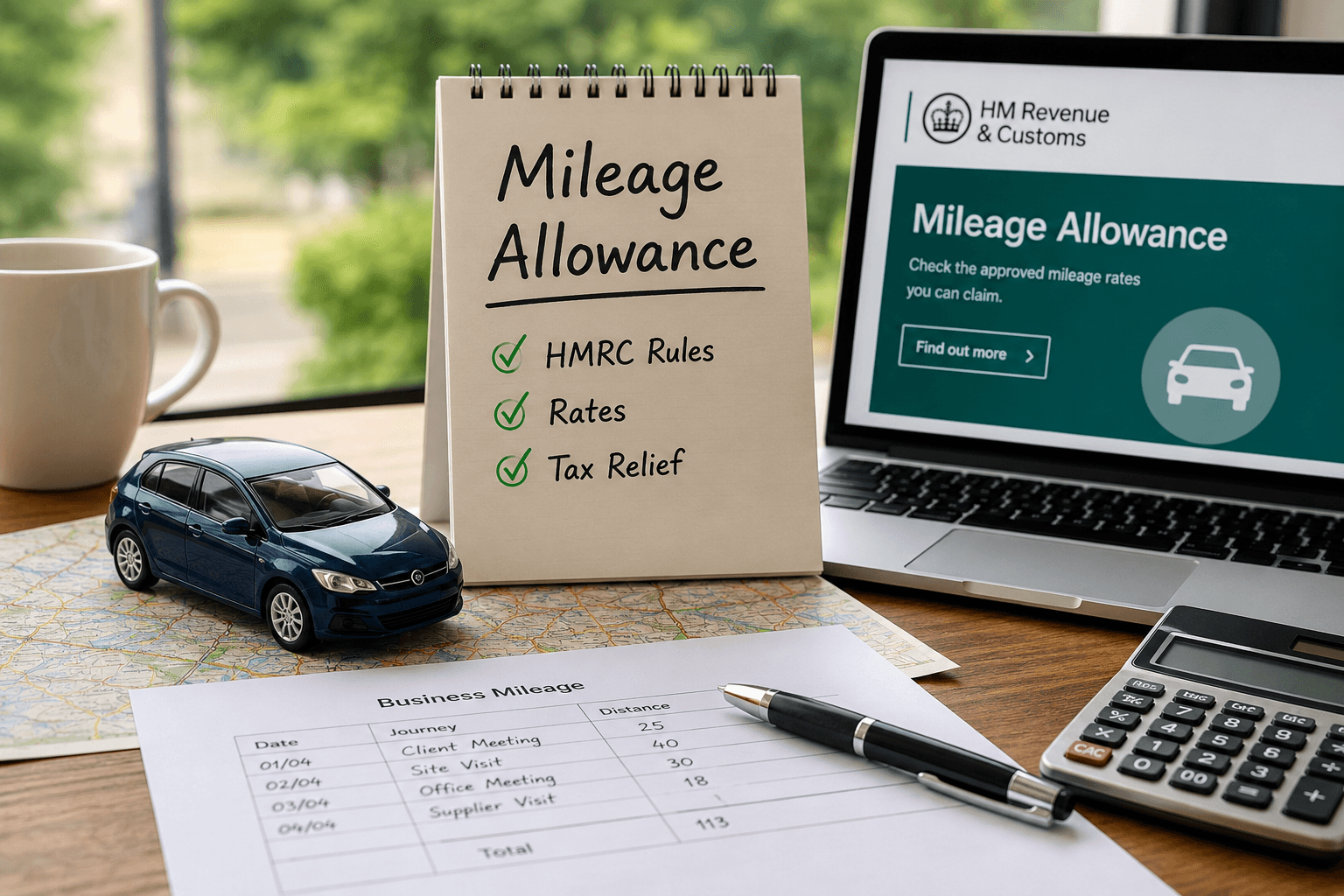
For fifteen years, the mileage allowance UK employers worked with was the one area of expenses policy nobody needed to revisit. The rate was 45p; it had been 45p since 2011, and every staff handbook, payroll template and expense app in the country was built around it.
That changed in May 2026 – and it changed retrospectively, which is why a good number of the businesses we support spent June unpicking payroll runs they thought were already closed.
If you employ people who drive their own cars for work, run a company car fleet, or file your own Self Assessment as a director or sole trader, the mileage allowance UK rules now look meaningfully different from the ones you were working to last year. This guide sets out where the mileage allowance UK businesses rely on currently stands for the 2026/27 tax year, what the change means in practice, and the points we most often find clients getting wrong when we take over their books.
Mileage Allowance UK 2026: 55p Per Mile, Backdated to 6 April
On 21 May 2026, HMRC confirmed that the approved rate for cars and vans would rise from 45p to 55p per mile for the first 10,000 business miles in a tax year. The rate for miles above 10,000 stays at 25p. It is the most significant revision to the mileage allowance UK drivers can claim in a generation.
Three things about this announcement matter more than the number itself:
It was backdated. The increase takes retrospective effect from 6 April 2026, so it applies to the whole of the 2026/27 tax year — including journeys already reimbursed at 45p in April and May.
It was the first movement since 2011. The 45p rate had been frozen for fifteen years while fuel, insurance, servicing and finance costs all climbed. A 22% uplift on the main rate is significant, even if it arguably still lags the real cost of running a car.
It only moved one of the rates. Motorcycles, bicycles, the 25p rate above 10,000 miles and the 5p passenger payment were all left alone. If you employ field staff who cover heavy annual mileage, a large share of their travel is still reimbursed at a rate set in 2001.
Mileage Allowance UK Rates for 2026/27
The table below sets out the full HMRC mileage rates now in force. These are the figures your expenses policy and payroll should be running on.
| Vehicle type | First 10,000 business miles | Each mile over 10,000 |
| Cars and vans | 55p | 25p |
| Motorcycles | 24p | 24p |
| Bicycles | 20p | 20p |
| Passenger payment (cars and vans) | 5p per passenger, per business mile | 5p |
These are the HMRC-approved mileage allowance figures – usually shortened to AMAPs, or Approved Mileage Allowance Payments. Pay at or below them, and there is no income tax, no National Insurance, no P11D entry and nothing to report. The mileage allowance UK employers operate under is one of the cleanest reliefs in the tax system, provided the underlying records hold up.
The same HMRC mileage rates apply identically in England, Scotland, Wales and Northern Ireland. There is no devolved variation, which is one less thing to worry about if you employ people across the four nations.
What the Backdated Mileage Allowance UK Change Means for Payroll
This is the part that caused the most work for our clients, and it splits into two scenarios. HMRC set out its expectations in Agent Update Issue 143.
If you reimbursed at 45p between April and the announcement, you can make a top-up payment covering the 10p per mile difference for those journeys. Because the whole payment still falls within the approved amount for 2026/27, the top-up is free of income tax and NIC. It is not compulsory — the AMAP rate is a ceiling, not a floor — but making the top-up is usually the tidier route, because otherwise each affected employee is left with a Mileage Allowance Relief claim they have to pursue themselves.
If you paid above 45p in April or May and put the excess through payroll as taxable pay, you may now have deducted tax and NIC you did not need to deduct. Those payroll runs may need correcting. We would suggest checking April and May before you get much further into the year, because unwinding it at year end is considerably more painful than doing it now.
There is also a National Insurance subtlety worth flagging, because it catches people out. For NIC purposes, the qualifying amount that can be disregarded from Relevant Motoring Expenditure is a flat 55p per mile — with no 10,000-mile threshold. So an employee doing 18,000 business miles has two different calculations running in parallel: a two-tier one for income tax, and a flat one for NIC. Payroll software generally handles this correctly, but manual calculations frequently do not.
Mileage Allowance UK Rules: What the Payment Actually Covers
A recurring misunderstanding is that mileage is a fuel reimbursement. It is not.
The mileage allowance on cars is designed to cover the full running cost of the vehicle across a business journey – fuel, insurance, road tax, servicing, tyres, MOT, repairs and depreciation. That is precisely why the rate drops to 25p after 10,000 miles: the fixed costs of owning the car are treated as largely recovered by that point, leaving mainly the marginal running costs.
Grasping this makes the rest of the mileage allowance UK regime far easier to apply, because it explains what can and cannot sit alongside a claim. If an employee claims 55p per mile and then separately claims for fuel, that second claim is not allowable. We see this most often with staff who have a fuel card and also submit mileage — it is double recovery, and it is one of the more common findings in an employer compliance review.
What you can reimburse on top, tax-free, are costs genuinely incidental to the journey and not related to running the car: business parking, congestion charges, tolls and ferry crossings. Parking fines and speeding penalties are never allowable, whoever pays them.
What Counts as a Business Mileage Claim
Getting the rate right is the easy part. Getting the journey right is where most exposure sits, and it is where a business mileage claim most often falls apart under scrutiny.
A valid business mileage claim covers travel undertaken in the performance of the duties of employment, or travel to a temporary workplace. In practice that means:
- Driving from your office to a client, supplier or site meeting
- Travelling between two workplaces of the same employer
- Journeys to a temporary workplace, including from home
- Site visits, deliveries and callouts
What does not qualify is ordinary commuting — home to a permanent workplace — regardless of how far it is, what time you set off, or whether you stopped to pick something up on the way. Private travel is likewise excluded.
The 24-Month Rule
The temporary workplace question is where the real risk lives, particularly for contractors, consultants and anyone on long client engagements.
A workplace stops being temporary once you expect to attend it for more than 24 months, or if you expect it to last for all or almost all of the remaining period of your employment. Crucially, the test is based on expectation, not hindsight. The moment you know the engagement will run beyond two years, travel to that site becomes ordinary commuting — even if you have not yet hit month 24.
We have seen assessments raised where a contract was extended in month 14, taking the total expected duration past 24 months, and mileage continued to be claimed for another year on the old basis. Reviewing engagement lengths against mileage records is a five-minute job that avoids a very expensive conversation — and no amount of care over the HMRC mileage rates will save a business mileage claim for a journey that never qualified in the first place.
Paying Above or Below the Approved Rate
Employers are not obliged to pay 55p. The HMRC approved mileage allowance sets the tax-free maximum, not a minimum entitlement — what you actually pay is a matter for the employment contract or expenses policy. This is the point about the mileage allowance UK framework that most surprises business owners: the rate is a ceiling, and nothing in tax law compels you to reach it.
If you pay above the approved rate, the excess is treated as taxable earnings. It goes through payroll or onto a P11D, and it attracts Class 1 National Insurance. There is no way to make an above-rate payment tax-free.
If you pay below the approved rate, nothing goes wrong for you as the employer — but you have quietly transferred an admin burden onto your staff and onto HMRC, because each employee can claim tax relief on the shortfall. A business reimbursing at 40p when the approved figure is 55p is generating a 15p-per-mile relief claim for every employee, every year. For a sales team, that adds up quickly and tends to surface as a staff grievance long before it surfaces as a tax issue.
Our usual advice is to reimburse at the full HMRC approved mileage allowance unless there is a specific commercial reason not to. It is the cheapest possible way to avoid both a benefit charge and a payroll headache, and it removes any need for your staff to claim mileage expenses separately from HMRC.
Mileage Allowance Relief: How Employees Claim the Difference
Where an employer pays less than the approved amount, the employee can claim Mileage Allowance Relief (MAR) on the shortfall. This is the mechanism that lets individuals claim mileage expenses directly from HMRC rather than through the payroll.
The critical point – and the one that generates the most disappointed phone calls – is that you get tax relief on the shortfall, not the shortfall itself. Relief is given at your marginal rate of income tax.
Worked example
Priya drives 8,000 business miles in 2026/27. Her employer reimburses at 30p per mile.
- Approved amount: 8,000 × 55p = £4,400
- Actually received: 8,000 × 30p = £2,400
- Shortfall: £2,000
Priya is a basic rate taxpayer, so she claims relief at 20% and receives £400. As a higher rate taxpayer, she would receive £800. She does not get the £2,000.
To claim mileage expenses as an employee, use form P87 or HMRC’s online service for tax relief on job expenses ewhere the total claim is £2,500 or less. Above that threshold, it goes through Self Assessment. Claims can be backdated four years from the end of the relevant tax year, so there is still time to pick up missed relief from 2022/23 onwards.
One quirk worth knowing: the 5p passenger payment works differently. If your employer pays it, it is tax-free. If your employer does not pay it, you cannot claim relief on it. It is the only part of the regime with no employee-side claim, which the ATT has asked the government to look at.
Company Car Mileage: A Completely Separate System
This is the single most common error we correct when onboarding a new client, so it is worth being blunt about it.
AMAP rates do not apply to company cars. If the business owns or leases the vehicle, company car mileage is reimbursed using Advisory Fuel Rates (AFRs), which are a different set of figures reviewed quarterly by HMRC – on 1 March, 1 June, 1 September and 1 December. The mileage allowance UK rules described so far apply only where the employee owns the vehicle.
Paying 55p per mile to someone driving a company car creates a taxable benefit on almost the entire payment. Paying 17p to someone driving their own car leaves them significantly out of pocket and generates a relief claim. Both errors are easy to make if your expense system has a single “mileage” category rather than separate routes for company car mileage and privately owned vehicles.
Advisory Fuel Rates from 1 June 2026
| Engine size | Petrol | Diesel | LPG |
| 1400cc or less | 14p | — | 11p |
| 1600cc or less | — | 15p | — |
| 1401cc to 2000cc | 17p | — | 13p |
| 1601cc to 2000cc | — | 17p | — |
| Over 2000cc | 26p | 23p | 21p |
Fully electric company cars: 7p per mile for home charging, 15p per mile for public charging.
These June figures were a sharp increase on the March quarter – petrol over 2000cc rose 4p and diesel over 2000cc rose 5p, reflecting the run-up in pump prices through the spring. If you have a mixed fleet doing real mileage, that is a genuine cost movement rather than a rounding difference, and your reimbursement budget for the second half of the year should reflect it.
Note the timing. The next quarterly revision takes effect on 1 September 2026. If you are reading this in August, now is the moment to diarise a policy check rather than discover in October that your company car mileage has been reimbursed on stale rates. HMRC allows the previous quarter’s rates to be used for one month after a change, which gives you a short grace period – but not an indefinite one.
A few further points on company cars:
- Hybrids and plug-in hybrids are treated as petrol or diesel according to their engine type. There is no separate hybrid rate.
- Electricity is not “fuel” for car fuel benefit purposes, so there is no fuel benefit charge on an electric company car.
- The two-tier EV rate requires you to know where the car was charged. Where a driver uses both home and public charging, HMRC accepts a fair and reasonable apportionment – but you need a basis for it, not a guess.
- You can pay a different rate if you can demonstrate the actual cost per mile is genuinely higher or lower for your vehicles. Keep the evidence on file, because you will be asked for it if the question ever arises.
- Private fuel repayments must be made in full by 6 July following the end of the tax year if you want to eliminate the car fuel benefit charge. A partial repayment does not give partial relief — the full flat-rate charge still applies, and it is usually far more expensive than the fuel was worth.
The VAT Point Most Businesses Miss
If you are VAT registered, you can reclaim input VAT on the fuel element of business mileage paid to employees – including where they are driving their own cars under the mileage allowance UK framework.
The fuel element is calculated using the AFR for the relevant engine size and fuel type, not the 55p AMAP rate. So for an employee driving a 1600cc petrol car on business:
- 500 business miles × 17p (AFR) = £85 fuel element
- VAT reclaimable: £85 × 1/6 = £14.17
To support the claim, you must hold VAT receipts for fuel purchases covering at least the amount being reclaimed. The receipts do not have to match individual journeys, but they must exist, and they must cover the value claimed.
For a business with several employees doing regular business travel, this is typically a few thousand pounds a year that goes unclaimed simply because nobody built the process. It is one of the first things we look at during a bookkeeping review.
Sole Traders and the Self-Employed
The mileage allowance UK sole traders use follows the same figures. Simplified mileage rates rose in step with AMAPs – 55p for the first 10,000 business miles and 25p thereafter for cars and goods vehicles, backdated to 6 April 2026.
You have a choice between:
Simplified mileage – a flat pence-per-mile figure covering all vehicle running costs. Straightforward, low-admin, and usually the better answer for lower-value vehicles and moderate mileage.
Actual costs – claiming the business proportion of every real expense (fuel, insurance, repairs, servicing, finance interest) plus capital allowances on the vehicle. More work, but often materially better for expensive vehicles, high-mileage users, or anyone with substantial finance costs.
Two rules to watch. You cannot use simplified mileage for a vehicle on which you have already claimed capital allowances. And once you choose a method for a particular vehicle, you must stick with it for as long as you own that vehicle — you cannot switch year to year to whichever produces the larger deduction.
For anyone weighing this up, we would generally run the numbers both ways before the first return is filed for a new vehicle, because that is the only point at which the decision is genuinely open.
Records: What HMRC Actually Expects
The HMRC mileage rates are published and easy to apply. Records are where claims fail.
To support any business mileage claim, keep the following for every journey:
- The date
- Start point and destination
- Purpose of the journey, and who was visited
- Business miles travelled
- Vehicle used
- Any passengers carried on business
A spreadsheet is perfectly acceptable. A GPS-based mileage app is better, because the contemporaneous timestamp is hard to challenge. What does not survive an enquiry is a round-number annual figure with no supporting detail — “approximately 9,000 miles” is an estimate, not a record, and HMRC treats it as one.
Round numbers in general invite attention. A claim for exactly 10,000 miles, sitting precisely at the threshold, tends to get a second look.
Keep records for at least five years after the 31 January submission deadline for the relevant tax year.
Five Mileage Allowance UK Mistakes We See Most Often
1. Mixing up AMAPs and AFRs. Company car drivers reimbursed at 55p, or private car users reimbursed at 17p. Both create problems, in opposite directions, and confusing the mileage allowance on cars owned personally with company car mileage rates is comfortably the most frequent error we correct.
2. Claiming the commute. Home to permanent workplace is not business mileage, and no amount of client work at the destination changes that.
3. Missing the 10,000-mile threshold. It resets on 6 April, and it applies per employee per employment. Employees who joined mid-year frequently have their opening position calculated incorrectly.
4. Double-claiming fuel. A fuel card plus a full mileage claim is duplicate recovery of the same cost.
5. Never revisiting the policy. Because the mileage allowance UK rate sat still for fifteen years, a great many expense policies still say 45p. If yours does, it is now out of date, and your staff are absorbing the difference.
What’s Coming Next for the Mileage Allowance UK Regime
The government has committed to a further review of the HMRC mileage rates at Budget 2026, so this year’s increase is explicitly not the end of the matter.
The Association of Taxation Technicians has argued for two further changes: removing the 10,000-mile distinction so a single rate applies to all business miles, and moving AMAPs onto a quarterly review cycle in the same way AFRs already work. The logic is hard to fault – a company car driver’s reimbursement tracks fuel prices four times a year, while a grey fleet driver’s was fixed for a decade and a half. Whether the Treasury adopts either point is another question, but it is worth knowing the direction of travel before you commit to a long-term expenses policy.
Our steer to clients is to build any car allowance or expenses framework so the pence-per-mile figure is a variable rather than a hard-coded number in a contract. Fifteen years of stability made that look unnecessary. It does not look unnecessary now.
Frequently Asked Questions
What is the mileage allowance UK employers can pay for 2026/27?
55p per mile for the first 10,000 business miles in cars and vans, then 25p per mile. Motorcycles are 24p and bicycles 20p, with no threshold for either. These HMRC mileage rates apply identically across England, Scotland, Wales and Northern Ireland.
Has the 45p rate really changed?
Yes. The mileage allowance UK rate for cars rose to 55p from 6 April 2026, announced on 21 May 2026 and backdated to the start of the tax year. It was the first change since 2011.
Can I claim mileage expenses if my employer pays less than 55p?
Yes. You can claim mileage expenses through Mileage Allowance Relief on the difference, but you receive tax relief at your marginal rate rather than the full cash shortfall.
Does the mileage allowance on cars apply to electric vehicles?
If you own the car personally, yes — the same 55p/25p structure applies regardless of fuel type. If it is a company-owned EV, company car mileage uses the advisory electricity rate instead: 7p per mile for home charging, 15p for public.
Can directors claim mileage?
Yes. A director using their own vehicle for qualifying business journeys claims the mileage allowance on cars on exactly the same basis as any other employee. Reimbursing at the full HMRC approved mileage allowance is usually the simplest and most defensible route.
Is commuting ever claimable?
Only where the destination is a temporary workplace. Travel to a permanent workplace never qualifies, and the 24-month rule determines which is which.
How far back can I claim?
Four years from the end of the tax year in question.
A Closing Thought
The mileage allowance UK businesses work with has just moved for the first time in fifteen years, and it is due another review within months. That combination – a retrospective change plus a signalled follow-up – is exactly the situation where policies drift out of date without anyone noticing, because the assumption that “mileage doesn’t change” is baked into a lot of finance functions.
Three practical actions worth taking this month:
- Confirm your expense policy and payroll settings reflect the current mileage allowance UK rate of 55p from 6 April 2026, and check whether April and May need correcting.
- Diarise the AFR revision on 1 September 2026 and set a recurring quarterly reminder for company car mileage.
- Check whether you are reclaiming VAT on the fuel element of mileage payments. Many businesses are not.
None of this is complicated. It is simply the kind of routine maintenance that slips when the underlying numbers have been static for a decade and a half.
If you would like a second pair of eyes on your expenses policy, your mileage records, or the treatment of a company car fleet ahead of the next P11D cycle, we are always happy to take a look.
Need help outsourcing this to a specialist team?
We handle bookkeeping, VAT, payroll, and year end accounts for UK accounting firms from India. Start with a free trial. No commitment required.