
Every practice has a version of the same July. Someone chases a leasing company for a list of registrations that should have arrived in May. A client’s HR manager confirms the private medical renewal on the 3rd, three days before filing. A manager who was supposed to be reviewing year-end accounts spends two days rebuilding a benefits schedule from a spreadsheet last touched by an employee who left in November.
That July is on its way out. But not in the shape most firms were preparing for eighteen months ago.
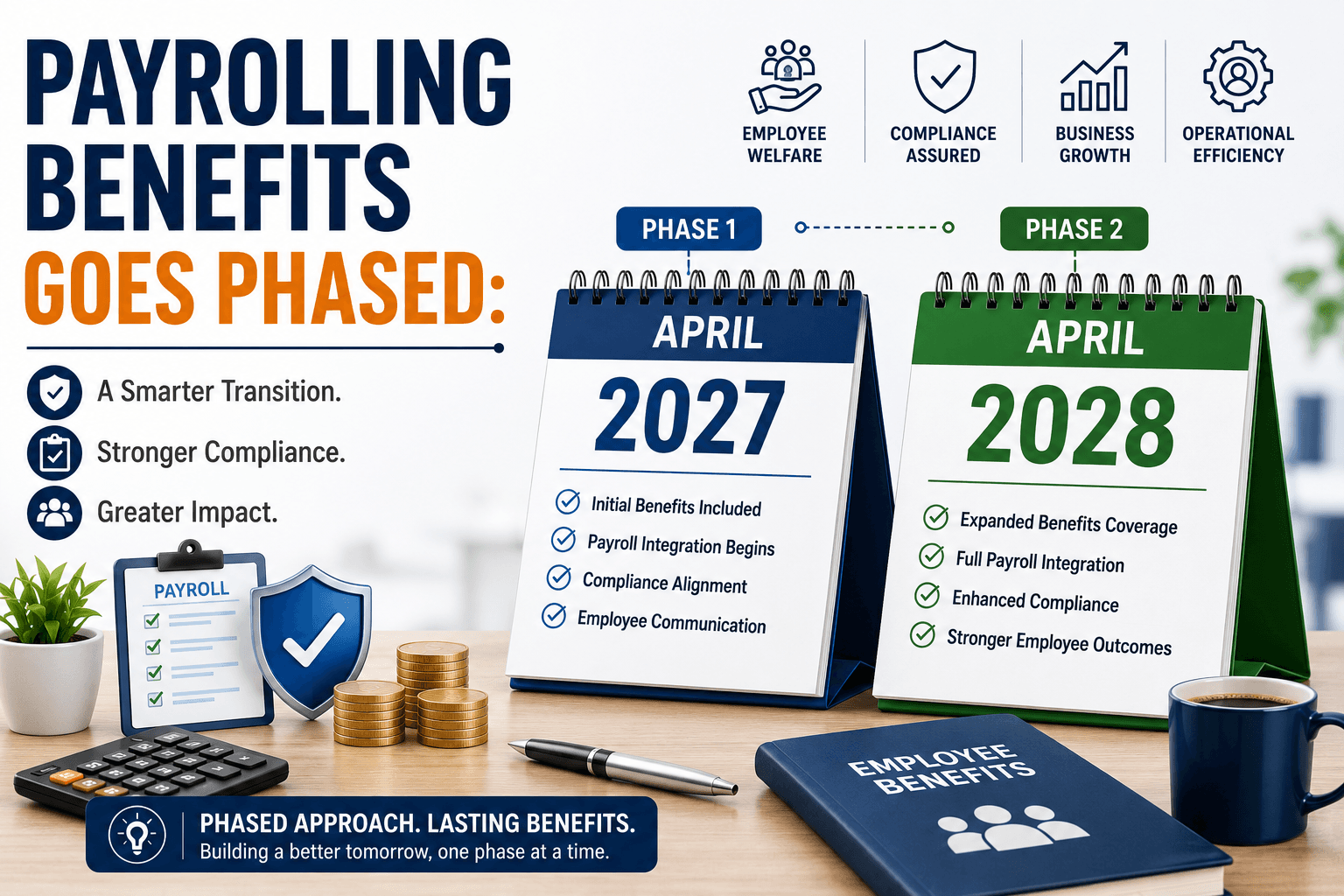
On 15 June 2026, HMRC confirmed that mandatory payrolling benefits will arrive in two phases rather than in one cutover. It is a sensible decision, and for most practices it is genuinely good news. It also creates a transitional period where two reporting systems run side by side, a cash-flow squeeze that lands squarely on your clients’ 2027/28 accounts, and a set of employee conversations that need to happen well before the first affected payslip goes out.
This article covers what actually changed, what it costs, and what to do about it between now and April 2027.
What HMRC changed in June 2026
The original position was straightforward enough. From 6 April 2027, almost every benefit in kind – everything bar employment-related loans and living accommodation – would have to be reported and taxed through payroll in real time. Income tax and Class 1A National Insurance both. One date, one switchover.
The problem was the plumbing. Employers were being asked to supply around 126 data fields through Real Time Information, covering benefits that in some cases are provided to a handful of people across the whole country. Software developers were still waiting on final technical specifications with less than a year to build, test and roll out. The professional bodies said publicly what most of us were saying privately: the timetable did not work.
HMRC listened, and the revised approach does three things.
It splits the population of benefits into two phases. A small group of common, well-understood benefits moves first, in April 2027. Most of the rest follows in April 2028.
It cuts the data burden sharply for the first phase. The requirement drops from around 126 fields to 32. Of those 32, roughly 14 already exist in RTI for company cars, so developers have about 18 genuinely new fields to build rather than a hundred-odd.
It leaves the hardest benefits alone for now. Employment-related loans and employer-provided living accommodation stay outside the mandatory regime with no confirmed date. Both have values that move during the year, and neither divides neatly into twelve equal slices, which is exactly why they have been parked.
The direction of travel has not changed. The P11D is still being retired. It is just being retired in instalments.
Which benefits move, and when
| Timing | What it covers | Reporting route |
| Phase 1 — from 6 April 2027 | Company cars, car fuel, vans, van fuel, and employer-provided medical and dental benefits (including private medical insurance) | Mandatory through the FPS. Income tax and Class 1A in real time |
| Phase 2 — from 6 April 2028 | Most remaining benefits and taxable expenses — gym memberships, non-cash vouchers, professional subscriptions, staff entertaining and the rest | Mandatory through the FPS |
| During 2027/28 only | Phase 2 benefits, before they become mandatory | P11D and P11D(b) as now — or voluntary payrolling if the employer registers |
| Outside the regime, date to be confirmed | Employment-related loans (including overdrawn director loan accounts charged below the official rate) and employer-provided living accommodation | P11D and P11D(b), or voluntary payrolling by registration |
The five phase 1 categories are estimated to account for around 92% of all benefits provided in the UK by volume. That statistic cuts both ways. It means most employers are affected from April 2027 – but it also means most employers only have a small, familiar group of benefits to get right in year one.
One caveat worth holding onto. The legislation and final guidance are expected during autumn 2026, and final software specifications are due somewhere between mid and late 2026. Treat the direction as settled and the fine detail as still moving. We are updating our own client briefings as each tranche lands, and we would suggest you build the same habit into your compliance calendar rather than writing a client note in September and assuming it holds through March.
What “payrolled” actually means in practice
If your firm already handles voluntary payrolling for some clients, the mechanics will be familiar. If not, here is the shape of it.
The employer works out the annual cash equivalent of each benefit – the same figure that would have gone on a P11D. That figure is divided by the number of pay periods in the year and added to the employee’s taxable pay each period as notional pay. Income tax is deducted on it in real time, alongside tax on salary. The benefit value and the associated Class 1A are reported on the Full Payment Submission for that period.
A few points that matter more than they might first appear:
No registration is needed for mandatory benefits. This trips people up because voluntary payrolling has always required registration in advance. From April 2027, phase 1 benefits are simply in scope. Registration is only required where an employer chooses to voluntarily payroll something outside the mandate – including loans and accommodation. That registration service is expected to open in November 2026, with a deadline of 5 April 2027.
HMRC will clear benefits out of tax codes before April 2027. This is designed to stop employees being taxed twice on the same benefit. Note the important exception: underpayments carried forward from earlier years stay in the code. We come back to this below, because it is the single most common source of “why has my pay dropped?” queries.
A reasonable estimate is expected where the value is not yet known. If a medical renewal lands in September, the employer is expected to payroll a sensible estimate from April and correct it later. HMRC has been clear that entering zero for a benefit that is obviously material is not an acceptable substitute for an estimate.
Employers still have to give employees an annual statement by 1 June. Payrolling does not remove the obligation to tell employees what was provided and what it was worth.
The cash-flow effect: Class 1A stops being a July problem
This is the part clients underestimate, and it is the part that belongs in a conversation with the finance director rather than the payroll clerk.
Under the current system, Class 1A is a single annual event. The P11D(b) is filed by 6 July, and the money leaves the bank by 22 July (19 July if paying by post). For a benefit provided in, say, May 2026, the employer holds that cash for fourteen months.
From April 2027, for phase 1 benefits, Class 1A is calculated each pay period and remitted with the normal monthly PAYE payment – due on the 22nd of the following month. The benefit provided in May 2027 is paid for on 22 June 2027.
That is an acceleration of up to eleven months on a liability that, for a client with a car fleet, can run well into five figures. It is not extra tax. It is the same money, earlier, and permanently earlier from that point on.
Three things to flag when you raise this with clients:
- Employment Allowance offers no relief here. It covers secondary Class 1 only. It has never applied to Class 1A, and that does not change. Clients who assume their allowance will soak up the monthly figure need correcting early.
- Quarterly payers lose some of the cushion. Employers remitting quarterly because average monthly PAYE is under £1,500 will still find the Class 1A rolled into those quarterly payments rather than deferred to July.
- The rate is not fixed forever. Class 1A has been 15% for 2025/26 and 2026/27. The rate for 2027/28 will be confirmed in the usual Budget cycle, and any change now feeds through to monthly cash rather than a single July figure.
The double-hit year, with numbers
Here is where it gets uncomfortable. In 2027/28, an employer with phase 1 benefits pays Class 1A twice over: the 2026/27 liability as a lump sum on 22 July 2027, and the 2027/28 liability in real time from the April 2027 payroll onwards.
Take a 40-employee engineering client on a monthly payroll:
- 18 company cars, average cash equivalent £6,400 – £115,200
- Fuel benefit on 4 of those cars, average £3,900 – £15,600
- Private medical for all 40, average £860 – £34,400
- Total phase 1 benefits: £165,200. Class 1A at 15%: £24,780, or roughly £2,065 a month.
Assume the 2026/27 figures were slightly lower, giving a Class 1A liability of £23,900 due on 22 July 2027. Assume they also provide around £18,000 of phase 2 benefits, carrying £2,700 of Class 1A.
Class 1A cash leaving the bank, by tax year:
| Tax year | Real-time Class 1A | July lump sum | Total |
| 2026/27 | — | £23,100 (2025/26 liability) | £23,100 |
| 2027/28 | £24,780 (phase 1) | £23,900 (2026/27 liability) | £48,680 |
| 2028/29 | £27,480 (phases 1 and 2) | £2,700 (2027/28 phase 2 items) | £30,180 |
| 2029/30 | £27,480 | — | £27,480 |
Rounded, and ignoring the one-month lag on each monthly remittance.
The Class 1A cost roughly doubles for a single year, then settles a little above the old baseline. There is a smaller second bump in 2028/29 as phase 2 benefits go through the same transition.
Say plainly to the client what this is and what it is not. It is not a tax rise. It is a one-off timing shift that happens to land entirely inside one set of statutory accounts. Where that matters – a bank covenant tested on cash, a tight overdraft, a business already managing a working capital squeeze – it needs to be in the forecast now, not discovered in July 2027.
For clients with substantial car fleets, this is also worth raising alongside any wider benefits review. If the fleet was already under discussion, the cash-flow profile is a legitimate input into that decision, and 2026/27 is the year to have the conversation rather than the year after the change lands.
In-year corrections and what they do to employee net pay
Real-time reporting narrows the correction window considerably. The annual P11D cycle gives an employer months to spot and fix a mis-stated benefit before anything is filed. Payrolling does not.
Where the correction happens depends on when the information arrives.
- Information arrives after the payroll cut-off but with pay periods left in the year: correct on the next FPS. The catch-up is collected through the employee’s pay.
- No pay periods left in the tax year: the end-of-year process applies. The employer amends the final FPS, with amendments reportable by 6 July following the year end and any additional Class 1A payable by 22 July.
- An employee makes good on a benefit: they have until 6 July following the year end to do so, and the employer has until 22 July to reflect it.
The employee-facing consequence is a catch-up deduction, and it can be sharp.
An employee on £62,000 takes delivery of a company car in April with a cash equivalent of £7,200. Payroll only picks it up in August. The monthly tax on the benefit is £240 at 40%. When it finally goes through, the August payslip carries five months in one go – £1,200 of tax on the benefit against a normal £240. That is roughly £960 gone from a single payslip on a net figure of around £3,300.
The tax is right. The timing is what generates the phone call.
The 50% overriding limit is the other trap. An employer cannot deduct more than 50% of an employee’s cash pay as tax in any pay period. Anything that cannot be collected is carried forward into later periods in the same tax year, and anything still outstanding at year-end goes to HMRC’s end-of-year reconciliation – a P800, a simple assessment, or self-assessment where the employee is already in the system.
This bites hardest in exactly the situations where clients are least likely to be watching:
- An employee on statutory maternity pay of around £700 a month who still has a £15,000 company car. Tax on the benefit is £500 a month; the 50% cap allows £350 in total. £150 rolls forward every month, and over nine months that is £1,350 chasing them into the following year.
- Employees on unpaid or reduced-hours leave who retain medical cover.
- Leavers who had a car for part of the year, where the final pay period cannot absorb the outstanding tax.
Directors and employees with no cash pay at all are not exempt – the benefits still have to be reported on an FPS and the Class 1A still falls due.
One piece of relief worth knowing about. HMRC has confirmed a soft landing for 2027/28: no inaccuracy penalties for payrolling errors unless the non-compliance is deliberate. That covers getting a value wrong. It does not cover filing late or paying late – those penalties and the associated interest apply as normal. From 2028/29 the standard penalty regime is expected to apply in full.
What the P11D(b) still does after 2027
There is a persistent assumption in the market that April 2027 kills the P11D outright. It does not, and the practices telling clients otherwise will be having awkward conversations in July 2028.
For 2027/28, most employers run two processes side by side. Phase 1 benefits go through payroll. Everything else – the gym memberships, the vouchers, the professional subscriptions – continues on P11D unless the employer has registered to payroll them voluntarily. The P11D(b) is still the declaration that those returns are complete and correct, and still the return of Class 1A on those benefits, filed by 6 July 2028 and paid by 22 July 2028.
Loans and accommodation keep the P11D route indefinitely. Until HMRC confirms a date for bringing them in, any employer with a beneficial loan or provided accommodation has an annual return to file regardless of how much else has moved to payroll.
The year-end process does not disappear either. Even where everything has been payrolled, there is still a reconciliation to do: checking that the values reported through the year were right, capturing corrections, and settling any additional Class 1A by 22 July. The July deadline gets smaller. It does not vanish.
PAYE Settlement Agreements are unaffected by any of this and continue as they are.
The decision your clients need to make by 5 April 2027
Because phase 2 benefits stay optional during 2027/28, every affected employer has a choice: run the hybrid, or voluntarily payroll the phase 2 items from April 2027 and deal with one system instead of two.
Voluntary payrolling of phase 2 items makes sense when the client has a modest, stable set of additional benefits, the payroll software handles them cleanly, and the practice would rather train the team once than twice. It also buys a full year of practice under the soft-landing regime before those benefits become mandatory.
It makes less sense when the additional benefits are hard to value in-year, arrive late from third parties, or involve loans and accommodation where the numbers genuinely move. Estimating a fluctuating loan balance across twelve pay periods and correcting it afterwards is more work than a single P11D, not less.
Registration opens in November 2026 and closes on 5 April 2027. That is a decision to make with each affected client before Christmas, not in the last week of March.
The client communication plan
The technical work is manageable. The communication work is what separates a smooth transition from a payroll inbox full of complaints in April 2027.
Run it in three waves.
Wave 1 – Autumn 2026: brief the employer
Aimed at the business owner or finance lead, not the payroll administrator.
Cover:
- Which of their benefits fall in phase 1 and which do not
- The Class 1A cash-flow profile, with their numbers, not generic ones
- The voluntary payrolling decision for phase 2 items, with a recommendation and a deadline
- What data you will need from them monthly, and where it currently sits
- Confirmation that their payroll software will support real-time benefit reporting
Wave 2 – January to March 2027: decisions and employee pre-notice
Registration decisions confirmed. Benefit data cleaned. And critically, the employee note goes out before the March payroll, not attached to the April payslip. People need to hear about a change to their pay before they see it, not at the same time.
Wave 3 – April to June 2027: first payslips and support
The first two or three payroll runs generate the queries. Have someone briefed to answer them. Then the annual statement to employees by 1 June.
What the employee note has to say
Five things, in plain language, in under a page:
- What is changing – tax on your company car and medical cover will now come out of your monthly pay instead of being collected through your tax code.
- That this is not a new tax and not a pay cut – the amount of tax is the same; it is just collected differently and at a different time.
- What the payslip will look like – the benefit appears as notional pay, which increases the taxable figure without increasing what is paid into the bank.
- The overlap warning. This is the one people miss. HMRC is removing benefits from tax codes, but underpayments from earlier years stay in the code. Some employees will see tax on this year’s benefits through payroll and an older underpayment still coming through their code. That combination can produce a real dip in take-home pay, and it needs flagging in advance rather than explained afterwards.
- Where to check and who to ask – the HMRC app or Personal Tax Account for their own figures, and a named person internally for payroll questions.
What not to say
Do not promise employees that their take-home pay will be unaffected. For anyone carrying a prior-year underpayment, or anyone whose benefit was previously under-collected through a code, it will change. A specific, honest note about a modest reduction lands far better than a reassurance that turns out to be wrong on payday.
What this does to your practice
Worth being blunt about the shape of the workload, because it changes more than the headline suggests.
The July peak spreads out. A single annual exercise per client becomes twelve monthly touchpoints. Total hours may not rise much – but they move from one compressed window you can staff for into a permanent monthly commitment that competes with VAT quarters, management accounts and payroll runs already in the diary.
The data is not where payroll is. Car details sit with the leasing company. Medical renewals sit with a broker. Joiner and leaver information sits with HR. Under a P11D cycle, that information could be gathered once and reconciled in June. Under real-time reporting, it has to arrive before every payroll cut-off, every month, for every affected client. Most practices we work with are finding this – not the tax calculation – is the genuine bottleneck.
A per-client benefit register becomes non-negotiable. Every benefit, every recipient, the annual value, the effective dates, and where the source data comes from. Without it, the estimates are guesswork and the corrections multiply.
Corrections are manual, and they are unpopular. Amending a payroll submission cannot be automated, and it has knock-on effects on the employer’s PAYE account, on internal reporting and on employee records. Getting the value right first time is worth real effort.
This is where a properly structured outsourced payroll function earns its place. Monthly RTI submissions, benefit data chased on a documented calendar, corrections handled inside the pay cycle rather than at year-end, and reviewer-ready reporting back to your managers — so the change lands as a process rather than as twelve months of firefighting.
A 90-day plan for autumn 2026
If your firm does nothing else between now and Christmas, do these.
Weeks 1–4: identify who is affected. Run a report across the portfolio for every client with a car, van, fuel, or medical benefit on a 2025/26 P11D. That is your phase 1 population. Rank it by benefit value – the biggest cash-flow impacts get the first conversations.
Weeks 5–8: confirm the software position. Speak to your payroll software provider about real-time benefit reporting and real-time Class 1A. Final specifications are due in the second half of 2026, so ask about their build timetable and their testing window, not just whether they intend to support it.
Weeks 9–12: model the cash and book the conversations. Produce the two-year Class 1A profile for every phase 1 client and get it in front of whoever owns their cash forecast. At the same time, make the voluntary payrolling recommendation for phase 2 items so registration can be dealt with before the 5 April 2027 deadline.
Run all of this alongside the 2026/27 P11D cycle rather than after it. That cycle – filed by 6 July 2027 – is the last full traditional run for cars and medical benefits at most employers, and it is the best data-quality audit you will get. Every gap it exposes is a gap that would otherwise surface in a live monthly payroll.
Timeline at a glance
| Date | What happens |
| November 2026 | Registration service opens for voluntary payrolling in 2027/28, including loans and accommodation |
| Autumn 2026 | Legislation and final HMRC guidance expected; revised technical specifications for phase 1 |
| Mid–late 2026 | Final software specifications issued to developers |
| 5 April 2027 | Deadline to register for voluntary payrolling for 2027/28 |
| Before April 2027 | HMRC removes benefits from employee tax codes (prior-year underpayments remain) |
| 6 April 2027 | Phase 1 mandatory: cars, car fuel, vans, van fuel, employer-provided medical |
| 6 July 2027 | Final full-scope P11D and P11D(b) for 2026/27 |
| 22 July 2027 | 2026/27 Class 1A lump sum due — alongside real-time Class 1A already running |
| 1 June 2028 | Annual benefit statement to employees for 2027/28 |
| 6 / 22 July 2028 | P11D, P11D(b) and Class 1A for benefits still outside the mandate in 2027/28 |
| 6 April 2028 | Phase 2 mandatory: most remaining benefits |
| To be confirmed | Loans and living accommodation |
Questions we are being asked
Does the 2026/27 P11D still need filing?
Yes. In full, by 6 July 2027, with Class 1A paid by 22 July 2027. Nothing about the phasing changes that.
Do employers need to register for mandatory payrolling?
No. Phase 1 benefits are automatically in scope from 6 April 2027. Registration is only needed for voluntary payrolling of anything outside the mandate.
A client already payrolls everything voluntarily. Does anything change for them?
Less than for most, but not nothing. From April 2027, the phase 1 benefits move to the new mandatory FPS data fields, while anything else they payroll continues under voluntary arrangements, with registration still required. They also need to work through the same real-time Class 1A cash-flow change.
Will employees pay more tax?
No. The same tax on the same benefits, collected in-year through pay rather than retrospectively through a tax code. Some employees will feel a temporary squeeze in 2027/28 where a prior-year underpayment is still running through their code at the same time.
What if a benefit value is not known in April?
Payroll a reasonable estimate and correct it when the actual figure arrives. Do not report zero for a benefit you know is material.
What happens to tax that cannot be collected because of the 50% cap?
It carries forward into later pay periods in the same tax year. Anything still uncollected at year-end is picked up by HMRC through a P800, simple assessment, or self-assessment.
Will HMRC charge penalties for getting it wrong in the first year?
Not for inaccuracies, unless the non-compliance is deliberate – that is the 2027/28 soft landing. Late filing and late payment penalties still apply as normal, and the full regime is expected from 2028/29.
Where this leaves you
The phasing has bought the profession something valuable: a year in which the change is real but contained. Five benefit categories, 32 data fields, and a soft landing on inaccuracies. Handled properly, 2027/28 is a manageable year that leaves your team fluent before phase 2 arrives with everything else.
Handled as an April 2027 problem, it becomes a scramble across three fronts at once — software that has not been tested, benefit data that has never been assembled monthly, and clients discovering a doubled Class 1A bill they were not warned about.
The practices that come through this well will be the ones that did the boring work in autumn 2026: identifying the affected clients, checking the software, modelling the cash, and getting the employee note written while there was still time to write it properly.
At Probal Global, we have spent over a decade running UK payroll for accountancy practices – RTI submissions, payslips, P60s, benefit reporting and monthly reporting packs that come back ready for your manager to review rather than ready to redo. As mandatory payrolling benefits comes in, we are building the monthly benefit data chase, the correction handling and the year-end reconciliation into the same delivery process, so the change lands as routine rather than as an extra job nobody has capacity for.
If you would like to talk through how your portfolio is affected, or test our payroll delivery on a live client before committing to anything, get in touch with our team – we will start with a free trial on a workflow of your choosing.
This article reflects HMRC guidance published to August 2026. Legislation and final technical specifications were still awaited at the time of writing, and some details may change. It is general information for UK accountancy practices and their clients, not advice for a specific business – please take advice on your own circumstances before acting.
Need help outsourcing this to a specialist team?
We handle bookkeeping, VAT, payroll, and year end accounts for UK accounting firms from India. Start with a free trial. No commitment required.