Every quarter, the same scene plays out in practices up and down the country. The VAT deadline lands. Three clients send their records four days late, one of them with a shoebox of receipts nobody has opened since April. A manager who should be reviewing year-end accounts spends two days rebuilding a purchase ledger instead. The return goes in on time, but only just, and nobody is entirely confident about the reverse charge treatment on that one subcontractor invoice.
We have been preparing VAT returns as an outsourced back office for UK accountancy firms for over a decade, and that pattern has barely changed. What has changed is the cost of getting VAT filing wrong.
Since HMRC replaced the old default surcharge with a points-based penalty regime for periods starting on or after 1 January 2023, and then raised late payment penalty rates from April 2025, the margin for error has narrowed sharply. A return that slips by three weeks now carries a calculable, invoiceable cost rather than a warning letter. For a practice, that cost lands twice: once on the client’s bank account, and once on your professional reputation.
This article sets out the VAT filing checklist our team works through on every job, the VAT return errors we correct most often, and what to do when something has already gone wrong. It is written for both sides of the relationship — the practice principal signing off the return, and the business owner supplying the records.
What VAT Filing Errors Actually Cost in 2026
Before the checklist, it helps to be precise about the exposure. HMRC VAT penalties now come from three separate regimes running in parallel, and a business that files late and pays late will meet all three at once.
1. Late submission penalty points
Each late VAT return earns one point. This applies even to nil returns and repayment returns – a detail that catches out dormant or seasonal clients every year.
| Filing frequency | Points threshold | Penalty at threshold |
| Monthly | 5 points | £200 |
| Quarterly | 4 points | £200 |
| Annual | 2 points | £200 |
Once the threshold is reached, a further £200 applies for every subsequent late submission. Points do not vanish quickly, either. Below the threshold, an individual point expires after 24 months. At the threshold, the business must complete a full period of compliance – 12 months for quarterly filers – and have submitted all returns due in the previous 24 months before the slate is wiped.
Points are not issued for a newly registered business’s first return, the final return after deregistration, or one-off returns covering a non-standard period.
2. HMRC late payment penalties
These are separate from the points system and are calculated on the money, not the paperwork. For VAT periods starting on or after 1 April 2025:
| When you pay | Penalty |
| Within 14 days of the due date | No penalty |
| Day 15 | 3% of the VAT outstanding at day 15 |
| Day 31 | A further 3% of the amount still outstanding at day 30 |
| Day 31 onwards | A second penalty accruing daily at an annualised 10% until the balance clears |
The first two charges can therefore reach 6% before the daily penalty even begins. These rates were increased from the original 2023 figures, so any internal guidance note written before 2025 is now understating the risk.
3. Late payment interest
On top of the penalties, HMRC charges interest from the day after the payment was due until it is paid in full. The rate is set at the Bank of England base rate plus 4%, which has stood at 7.75% since 9 January 2026. Interest and penalties are not alternatives – they run together.
A worked example. A business owes £30,000 of VAT due on 7 May and pays on 20 June, 44 days late. The first penalty is 3% at day 15 (£900) plus 3% at day 30 (£900), totalling £1,800. The second penalty runs at roughly £8.22 a day from day 31, adding about £115. Interest at 7.75% over 44 days adds a further £280 or so. Total cost of a six-week delay: comfortably over £2,000 – before anyone has spent an hour dealing with it.
If cash is genuinely tight, a Time to Pay arrangement agreed before a penalty triggers will stop late payment penalties accruing on the covered amount, though interest continues. Arranging one early is almost always cheaper than staying silent.
The VAT Return Errors We Correct Most Often
Over ten-plus years of UK VAT filing work, the same handful of mistakes account for the overwhelming majority of adjustments. None of them are exotic. All of them are preventable with a proper VAT return checklist.
1. Reclaiming input VAT without a valid VAT invoice. A supplier statement, a pro forma, a card receipt with no VAT number – none of these support a claim. This is the single most common finding in an HMRC compliance check.
2. Recovering VAT on blocked or partly blocked expenditure. Business entertainment, most car purchases, and the private element of mixed-use costs. Client lunches posted to a generic “entertainment” code with VAT reclaimed is a perennial.
3. Getting the Domestic Reverse Charge wrong in construction. Either applying it where the customer is an end user, or missing it entirely and charging VAT that the customer then reclaims. Both create problems for two businesses at once.
4. Confusing zero-rated, exempt and outside-the-scope supplies. They behave very differently in the return, and treating exempt income as zero-rated quietly distorts the Box 6 figure and any partial exemption calculation.
5. Cut-off errors around the period end. Invoices dated in the quarter but entered after the return was prepared, or deposits and advance payments recognised at the wrong tax point.
6. Duplicated purchase invoices. Usually where the same bill arrives by email and by post, or where a bank feed and a manual entry both land in the ledger.
7. Unreconciled bank and control accounts. If the VAT control account has never been agreed to the return, nobody actually knows whether the figures are right.
8. Flat Rate Scheme miscalculations. Applying the wrong sector percentage, forgetting the first-year discount has ended, or missing that the business has become a limited cost trader and must use 16.5%.
9. Overseas transactions handled on autopilot. Postponed VAT Accounting statements not downloaded, reverse charge on imported services ignored, or OSS obligations overlooked by e-commerce sellers.
Each of these is a small thing on its own. Stacked across a portfolio of a hundred VAT-registered clients, they are the difference between a VAT filing process that runs cleanly and one that turns every quarter into firefighting.
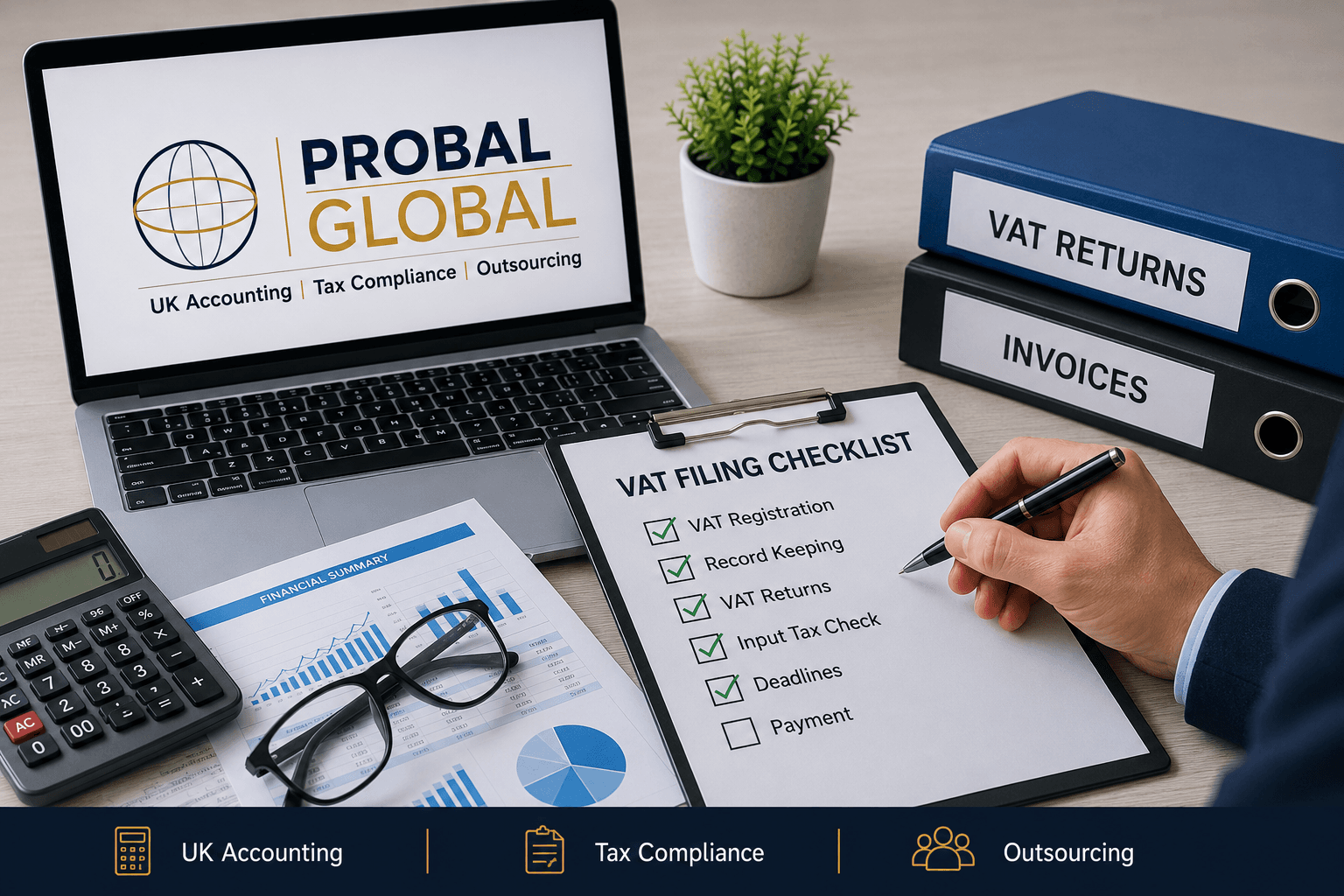
The VAT Filing Checklist
This is the working checklist our team applies to every VAT filing job before it goes back to the client’s reviewer. It is deliberately organised by when each task happens, because most VAT return errors are timing failures rather than technical ones.
Stage 1 – Before the VAT period closes
- Confirm the VAT scheme in use: Standard, Cash Accounting, Flat Rate, Annual Accounting, Margin or TOMS. Check it is still the right one – businesses outgrow schemes.
- Confirm the stagger group and the exact VAT filing deadline (one calendar month and seven days after the period end for most filers).
- Check whether turnover has crossed the £90,000 registration threshold on a rolling 12-month basis, or fallen below the £88,000 deregistration threshold.
- Chase outstanding purchase invoices before the period closes, not after.
- Confirm the client’s records are complete: bank feeds current, sales invoices raised, expense claims submitted.
Stage 2 – Preparing the return
- Reconcile every bank and credit card account to the closing statement balance. No exceptions.
- Reconcile the VAT control account to the return. If it does not agree, find out why before submitting.
- Review the sales ledger for correct VAT rate application, particularly zero-rated, reduced-rated and exempt lines.
- Verify a valid VAT invoice exists for every material input VAT claim.
- Remove VAT on business entertainment, blocked car costs and any private-use proportion.
- Apply the Domestic Reverse Charge correctly and confirm end user status in writing where relevant.
- Download and post Postponed VAT Accounting statements for the period.
- Check the reverse charge on imported services and digital supplies.
- Run the partial exemption calculation where the business makes exempt supplies, and confirm whether the de minimis limits are met.
- Review capital goods scheme adjustments if any qualifying assets are held.
- Scan for duplicate postings and credit notes not matched to invoices.
- Check bad debt relief eligibility – the debt must be over six months past its due date and written off in the accounts.
Stage 3 – Pre-submission review
- Compare each box against the equivalent quarter last year and the immediately preceding quarter. Investigate any movement you cannot explain in a sentence.
- Sense-check the effective VAT rate: Box 1 divided by Box 6 should land near 20% for a standard-rated business. A sharp variance is usually a coding error.
- Confirm Box 6 excludes VAT and includes zero-rated and exempt supplies as required.
- Confirm the return will be submitted through MTD-compatible software with a digital link back to the underlying records. Manual retyping breaks the digital link requirement.
- Have someone other than the preparer review the return. A second pair of eyes catches more than any software validation rule.
- Retain the working papers supporting every box figure.
Stage 4 – After submission
- Confirm HMRC has issued a submission receipt and store it.
- Diarise the payment date and confirm the Direct Debit is active. Direct Debit is the single most effective control against HMRC late payment penalties.
- Tell the client the payment amount and date in writing, well ahead of the deadline.
- File working papers, reconciliations and the receipt in one place for the six-year retention period.
- Note any judgement call or estimate made, so the next quarter’s preparer sees the reasoning.
Practices that run this VAT return checklist consistently tend to find that quarter-ends stop being a crisis and start being a routine. The work does not get smaller – it just stops arriving all at once.
How to Correct VAT Errors (The Rules Changed in September 2025)
Even a disciplined VAT filing routine will occasionally produce something that needs fixing. This is the section most guidance still gets wrong, so it is worth being clear.
Form VAT652 was withdrawn on 5 September 2025. If your firm’s procedures notes still reference it, they need updating. Corrections are now made in one of three ways: by adjusting the next return, through HMRC’s online error correction service via Government Gateway, or in writing.
Method 1 – Adjust the next return
You can correct VAT errors on your next return where the net value of the error is:
- £10,000 or less, or
- between £10,000 and £50,000 and less than 1% of the Box 6 figure for the period in which the error was found.
The net value is the additional VAT owed to HMRC less any additional refund due. So an output VAT understatement of £11,000 combined with an input VAT underclaim of £2,000 nets to £9,000 and falls inside Method 1.
Adjust Box 1 (VAT owed to HMRC) or Box 4 (VAT reclaimable) accordingly. Where reasonable care was taken, no penalty applies, and no interest is charged.
Method 2 – Notify HMRC separately
You must use the online correction service (or write to HMRC) where the error exceeds £50,000, falls between £10,000 and £50,000 and breaches the 1% test, or was deliberate. Late payment interest will be charged on Method 2 corrections.
The point most people miss
Correcting an error on your next return does not count as telling HMRC about it. If the error was careless, an unprompted separate disclosure is what unlocks the penalty reduction — and the difference between an unprompted and a prompted disclosure is substantial. Deliberate errors must always be notified separately, without exception.
Our standing advice to the practices we work with is simple: if there is any doubt about whether an error was careless, disclose it. The downside of an unnecessary disclosure is a short letter. The downside of a missed one is a penalty assessed on the wrong footing.
Sector-Specific VAT Filing Traps
Generic checklists take you most of the way. These are the sector points that consistently need a specialist eye.
Construction. The Domestic Reverse Charge remains the biggest single source of VAT return errors in this sector. End user and intermediary status must be confirmed in writing and re-confirmed when the relationship changes. CIS deductions and VAT interact but are not the same thing, and applications for payment have a different tax point from invoices.
Hospitality. Mixed supply rates across food, drink and accommodation, plus the treatment of service charges, tips and Tronc arrangements. EPOS exports need reconciling to the ledger rather than trusted wholesale.
Retail and e-commerce. Marketplace facilitator rules mean the platform sometimes accounts for the VAT and sometimes does not. Add OSS or IOSS obligations for EU sales, multi-currency settlements, and the gap between gross sales and net payouts on Shopify or Amazon, and reconciliation becomes a genuine exercise rather than a tick-box.
Property and real estate. Option to tax elections, the distinction between residential and commercial supplies, and the capital goods scheme on properties over £250,000.
Professional services. Place of supply rules for overseas clients, disbursements versus recharges, and partial exemption where any exempt income exists.
If you handle clients in these sectors, build a short sector-specific addendum onto your standard VAT filing checklist. A general VAT filing review will not catch a missed option to tax.
VAT Compliance UK: Building a VAT Filing Process That Holds Up
Three things separate practices that file cleanly from those that do not, and none of them are about technical VAT knowledge.
The work starts earlier. Records are chased in week one of the new quarter, not week three. A VAT filing process that begins ten days before the deadline will fail eventually, no matter how good the preparer is.
The same checklist is used every time, by everyone. Consistency beats individual brilliance. When every job passes through the same documented VAT return checklist, quality no longer depends on which member of staff happened to pick it up.
There is a genuine review layer. Preparation and review are separate functions performed by different people. This is the control that catches the reverse charge error, the duplicated invoice, and the odd-looking Box 6 movement before HMRC does.
Strong VAT compliance in UK practices is not built on clever technical work. It is built on boring, repeatable process – which is precisely why VAT filing transfers so well to a properly managed offshore team.
Where Outsourced VAT Support Fits
For most UK practices, VAT is high-volume, deadline-driven, low-margin work that competes directly with the advisory work partners would rather be doing. It is also the work that generates the most client friction when it goes wrong.
At Probal Global, we run MTD-compliant VAT filing as an extension of UK accountancy practices — across Standard, Flat Rate, Cash Accounting and TOMS schemes. Returns come back reconciled, with exception checks completed and reviewer-ready working papers attached. Ready to review, not ready to redo.
What that looks like in practice:
- Standard five working-day turnaround, with quarter-end peaks worked to your timeline rather than ours.
- Your software, not ours. Xero, QuickBooks, Sage, FreeAgent and Zoho Books, alongside IRIS, TaxCalc, CCH and BrightPay.
- A documented checklist on every job, so the tenth return of the quarter gets the same treatment as the first.
- Chartered Accountants and qualified staff with a minimum of three years’ UK accounting experience, trained on current HMRC requirements.
- GDPR-compliant, ISO 27001 aligned processes, encrypted transfer, role-based access and a signed NDA before any file moves.
- Around 60% cost saving against a local hire, with no employer NI, pension or recruitment overhead.
The team also handles bookkeeping, payroll, CT600 corporation tax and year-end accounts, with sector experience across construction, hospitality and e-commerce.
Frequently Asked Questions
What is the VAT filing deadline in the UK?
For most VAT-registered businesses, both the return and the payment are due one calendar month and seven days after the end of the VAT period. A quarter ending 31 March has a deadline of 7 May. Businesses on Annual Accounting and those paying by direct debit have different arrangements, so confirm the dates shown in the business tax account rather than assuming.
Do I still get a penalty point if I file a nil VAT return late?
Yes. Nil returns and repayment returns both attract a point if submitted late. This catches out dormant companies and seasonal businesses more often than any other rule in the regime.
How much are HMRC late payment penalties on VAT?
Nothing if you pay within 14 days of the due date. From day 15, 3% of the outstanding VAT, plus a further 3% of whatever remains outstanding at day 30. From day 31, a second penalty accrues daily at an annualised 10% until the balance is cleared. Interest at base rate plus 4% – currently 7.75% – runs alongside all of it from day one.
Can I still use form VAT652 to correct VAT errors?
No. VAT652 was withdrawn on 5 September 2025. Errors are now corrected either by adjusting the next return, where the value falls within the £10,000 / £50,000 and 1% thresholds, or through HMRC’s online error correction service.
Does correcting an error on my next return count as telling HMRC?
No, and this distinction matters. Where an error was careless, a separate unprompted disclosure is required to secure the reduced penalty position. Deliberate errors must always be notified separately.
How can a small business reduce VAT filing errors without hiring more staff?
Fix the timing first. Chase records in week one of the new quarter, reconcile the bank and VAT control accounts before the return is prepared, and have a second person review it. Those three habits remove most VAT return errors on their own. Where the volume genuinely exceeds the team, outsourcing the preparation while keeping review in-house is usually cheaper and faster than recruiting.
What is the VAT registration threshold for 2026/27?
£90,000 of taxable turnover on a rolling 12-month basis, with a deregistration threshold of £88,000. Both have been unchanged since April 2024. The test looks back over the previous 12 months from the end of every calendar month – it does not reset at the tax year end.
Is spreadsheet-based VAT filing still allowed under MTD?
Only with approved bridging software maintaining a digital link to HMRC’s API. Making Tax Digital has applied to all VAT-registered businesses regardless of turnover since April 2022, and manually retyping figures between systems breaks the digital link requirement.
The Bottom Line
Most VAT return errors are not technical failures. They are process failures – records chased too late, a reconciliation skipped under deadline pressure, a review that happened in name only. The technical knowledge required for accurate VAT filing is well within reach of any competent finance team. The discipline to apply it consistently, across every client and every quarter, is the harder part.
With HMRC VAT penalties now biting faster and interest running at 7.75%, the case for a documented, repeatable VAT filing process has rarely been stronger. Use the checklist above, apply it to every return, and make sure someone other than the preparer signs it off.
If VAT filing is the workflow eating your team’s capacity every quarter, we can take it off the bench. Start with a free trial on a single client return and see how the work comes back — or talk to our team about how VAT filing support would fit your existing review process.
Probal Global provides outsourced accounting, bookkeeping, VAT filing, payroll and tax support to UK accountancy practices. Rates, thresholds and penalty positions stated are correct at the time of writing; always confirm current figures on GOV.UK. This article is general guidance and not a substitute for advice on a specific client’s circumstances.
Need help outsourcing this to a specialist team?
We handle bookkeeping, VAT, payroll, and year end accounts for UK accounting firms from India. Start with a free trial. No commitment required.