VAT can be straightforward when your business is small, and transactions are simple. As turnover grows, however, choosing the right VAT method can make a noticeable difference to your cash flow, administration, and the amount of time you spend managing your accounts.
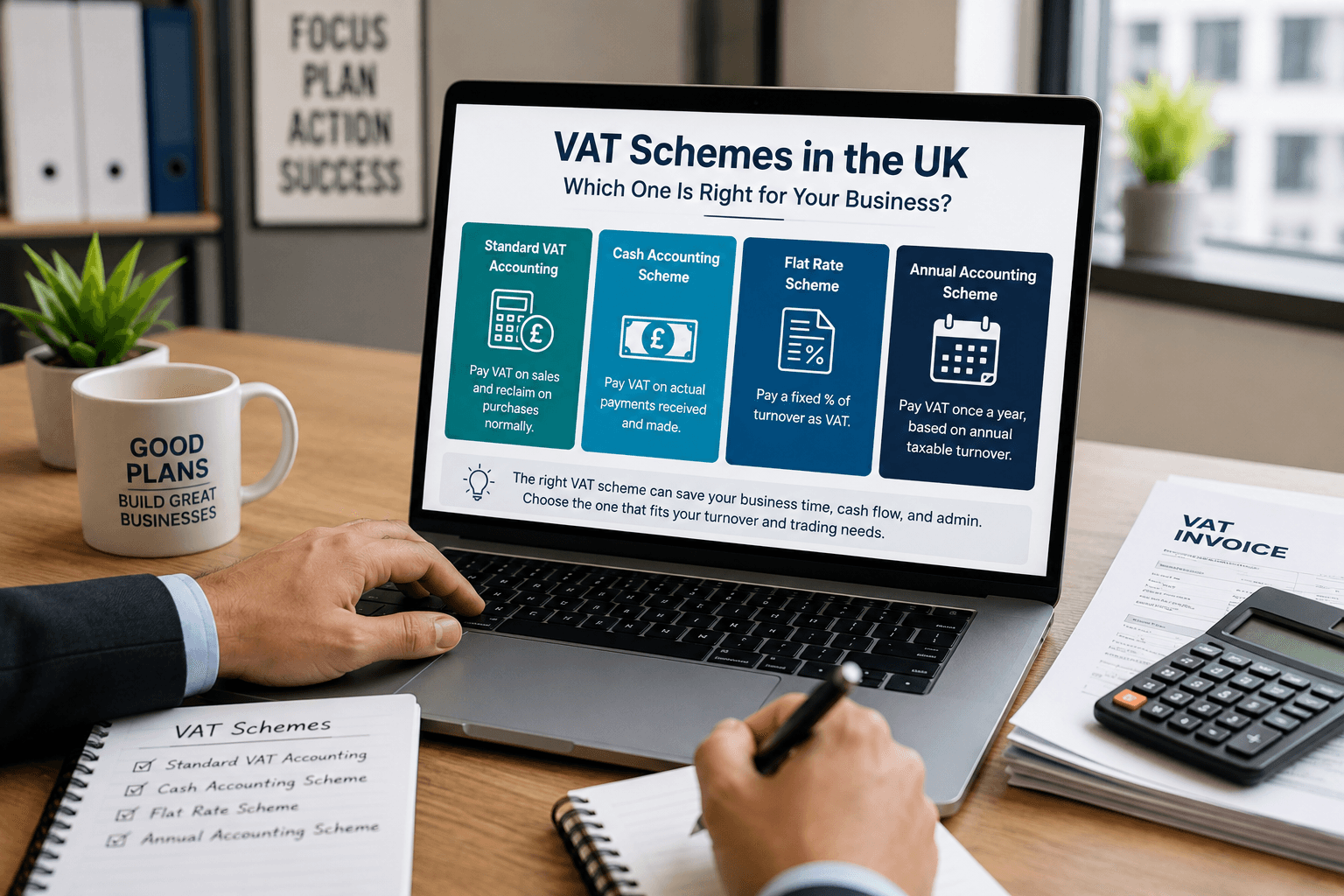
There are several VAT Schemes available to eligible UK businesses, including the Flat Rate Scheme, Cash Accounting Scheme and Annual Accounting Scheme. There are also specialist VAT schemes for particular industries and types of transactions.
At Probal Global, we support UK businesses and accounting professionals with practical outsourced accounting and bookkeeping services. Our approach is not simply to process VAT returns. We look at how a business operates, how customers pay, how much input VAT is being recovered, and how much administration the business can realistically manage before recommending an approach.
In this guide, we explain the main VAT Schemes, who they may suit and what businesses should consider before making a change.
What Are VAT Schemes?
VAT Schemes are HMRC-approved methods that can simplify the way VAT-registered businesses calculate, report and pay VAT. They do not normally change the VAT rates charged to customers; instead, they change how a business accounts for VAT.
HMRC currently identifies several schemes, including:
- VAT Flat Rate Scheme
- VAT Cash Accounting Scheme
- VAT Annual Accounting Scheme
- VAT Retail Schemes
- VAT Margin Schemes
- Capital Goods Scheme
- Tour Operators Margin Scheme
The right option depends on your turnover, industry, transaction structure, payment terms and accounting processes.
This is why choosing between VAT accounting schemes should be treated as a business decision rather than simply an accounting administration task.
The Main VAT Schemes UK Businesses Should Know
1. VAT Flat Rate Scheme
The Flat Rate Scheme is designed mainly for smaller VAT-registered businesses. If eligible, a business applies a fixed percentage based on its trade sector to its gross turnover when calculating the VAT it owes to HMRC.
Businesses generally need expected VAT-taxable turnover of £150,000 or less, excluding VAT, to join the scheme. There are also specific restrictions and conditions that need to be considered.
The main attraction is simplicity.
Instead of calculating output VAT and reclaimable input VAT in the same way as standard VAT accounting, the business uses the applicable flat-rate percentage.
However, simplicity does not automatically mean lower VAT costs.
A business with significant VAT-bearing expenses may find that standard VAT accounting produces a better result. The calculation should therefore be based on the actual numbers rather than assuming that the Flat Rate Scheme is always better.
2. VAT Cash Accounting Scheme
The Cash Accounting Scheme can be particularly useful for businesses that regularly give customers credit or experience delays in receiving payment.
Under this method, VAT is generally accounted for when customers pay rather than simply when invoices are issued. This can help businesses avoid paying VAT to HMRC before receiving the related customer payment.
Businesses can generally use the scheme if their expected VAT-taxable turnover is £1.35 million or less in the next 12 months, subject to HMRC’s eligibility conditions. Businesses must leave the scheme if taxable turnover exceeds £1.6 million.
For example, imagine a consultancy issues a £12,000 VAT-inclusive invoice to a client in June, but the client does not pay until September.
With standard VAT accounting, the VAT may become due based on the tax point created by the invoice or supply. Under cash accounting, the VAT treatment generally follows receipt of payment.
This can make the accrual VAT scheme comparison particularly important.
Strictly speaking, businesses often use the phrase “accrual VAT scheme” when referring to the normal or invoice-based VAT accounting method. It is not the formal name of a separate HMRC scheme. Under normal VAT accounting, VAT is generally accounted for based on the tax point rather than waiting for customer payment.
3. VAT Annual Accounting Scheme
The Annual Accounting Scheme VAT option is designed to reduce the frequency of VAT return submissions.
Eligible businesses generally submit one VAT return each year instead of four. They normally make interim payments based on an estimate of their annual VAT liability, followed by a balancing payment or repayment when the annual return is completed.
The scheme can be useful for businesses that want greater consistency in their VAT payments and less frequent VAT return administration.
HMRC currently states that businesses expecting VAT-taxable turnover of £1.35 million or less may be eligible, subject to the scheme’s conditions.
However, annual accounting for VAT does not mean that VAT records only need to be maintained once a year.
Your bookkeeping still needs to be accurate throughout the year. Sales, purchases, VAT invoices, credit notes and adjustments should be recorded properly so that the annual VAT calculation is reliable.
4. VAT Retail Schemes
Retail businesses can have a high volume of individual transactions, making standard VAT calculations more time-consuming.
VAT Retail Schemes provide alternative ways for eligible retailers to calculate VAT without necessarily calculating VAT separately on every individual sale.
Retail schemes can also be used alongside the Cash Accounting Scheme and Annual Accounting Scheme where the relevant conditions are met.
The best approach depends on the retailer’s sales mix, pricing structure and accounting system.
5. VAT Margin Schemes
Margin schemes are relevant to certain businesses dealing in goods such as second-hand items, antiques and other qualifying transactions.
Instead of accounting for VAT on the full selling price, the scheme can allow VAT to be calculated on the margin between the purchase price and selling price, subject to the detailed rules.
These schemes are highly transaction-specific, so businesses should establish whether their goods qualify before applying the treatment.
VAT Accounting Schemes: Which One Should You Choose?
There is no universal “best” option.
The best VAT scheme for small businesses depends on how the business earns money and how it manages its costs.
Before changing schemes, consider the following:
1. Your VAT-taxable turnover
Turnover is one of the first eligibility tests for several VAT Schemes.
For example, the Flat Rate Scheme has a £150,000 eligibility threshold excluding VAT, while the Cash Accounting and Annual Accounting Schemes generally have a £1.35 million expected taxable turnover threshold.
Your forecast should therefore be realistic, particularly if your business is growing quickly.
2. How quickly customers pay
If customers commonly pay 30, 60 or 90 days after invoicing, Cash Accounting may deserve consideration.
It can help align VAT payments with actual cash receipts, although there are transactions that are subject to special rules and exceptions.
3. Your level of business expenses
A business with substantial VAT-bearing expenses should carefully compare the financial impact of different VAT Schemes.
For example, the Flat Rate Scheme may simplify administration but may not always produce the lowest VAT cost for a business with significant input VAT.
4. Your administrative workload
If your finance team spends considerable time preparing quarterly VAT returns, the Annual Accounting Scheme may provide an administrative advantage.
However, reduced filing frequency should not be confused with reduced bookkeeping responsibility.
5. Your industry
The most suitable VAT treatment for a consultancy may be very different from that of a retailer, construction business, online trader or second-hand goods dealer.
Industry-specific VAT rules can also affect the decision.
Annual Accounting Scheme VAT: Is It Worth Considering?
Businesses often search for annual accounting scheme VAT options because they want to simplify VAT administration.
The potential advantages include:
- One VAT return each year instead of four
- More predictable interim payments
- Potentially easier cash-flow planning
- Additional time to submit the annual return and balancing payment
- An opportunity to align the VAT year with the business’s accounting year
HMRC states that Annual Accounting can help smooth cash flow through regular payments and reduce the number of VAT returns submitted.
However, there are potential drawbacks.
If your business experiences significant changes in turnover during the year, estimated payments may not accurately reflect your eventual VAT liability. You also need reliable bookkeeping throughout the year to avoid a large year-end surprise.
For some businesses, quarterly VAT returns provide useful financial discipline and more regular visibility over VAT.
Can You Combine Different VAT Schemes?
In some circumstances, yes.
For example, HMRC allows eligible businesses to use the Annual Accounting Scheme alongside the Flat Rate Scheme. Annual Accounting can also be used with the Cash Accounting Scheme and certain other schemes, subject to the applicable rules.
This is important because the decision does not always have to be “one scheme or another”.
A business may be able to combine schemes in a way that reduces administration while still producing an appropriate VAT treatment.
However, the interaction between schemes can become complicated. The business needs to understand which rules apply to each transaction and whether the combination actually benefits the business financially.
Common Mistakes Businesses Make With VAT Schemes
Choosing a scheme based purely on convenience can create problems.
Choosing the Flat Rate Scheme without doing the numbers
A lower administrative burden does not necessarily mean a lower overall VAT liability.
Assuming Annual Accounting removes the need for regular bookkeeping
It does not. Your records still need to be kept up to date throughout the year.
Ignoring customer payment patterns
If your business has long payment periods, the Cash Accounting Scheme may be worth investigating.
Failing to monitor turnover
Eligibility thresholds matter. A growing business should regularly review whether it remains eligible for its chosen scheme.
Treating VAT as an afterthought
VAT should be considered alongside pricing, cash flow, bookkeeping and wider financial planning.
Changing schemes without checking the transition rules
Leaving or joining a VAT scheme can create adjustment requirements. The timing of the change can also affect how VAT is reported.
How Probal Global Can Help With VAT Accounting
At Probal Global, we understand that UK businesses need more than basic bookkeeping support. They need accounting processes that are accurate, practical, and aligned with the way their business actually operates.
Our outsourced accounting support can help businesses with:
- VAT bookkeeping and reconciliation
- VAT return preparation
- Review of VAT treatment
- Cash-flow-focused VAT accounting
- Annual accounting support
- Accounts payable and receivable
- Management accounts
- Bookkeeping process improvements
- Accounting data checks
- Support for UK accounting practices and businesses
Our approach is to review the numbers first and then consider which VAT accounting schemes may be appropriate.
We do not recommend a VAT scheme simply because it is easier to administer. We consider turnover, payment cycles, expenses, industry, bookkeeping quality, and the likely financial impact.
For UK Chartered Accountants and accounting firms looking to outsource routine accounting work, this approach can also provide additional capacity without compromising on accuracy or client service.
You can learn more about our accounting outsourcing services at Probal Global.
A Practical VAT Scheme Comparison
| VAT Scheme | Generally Suitable For | Main Advantage | Key Consideration |
| Flat Rate Scheme | Eligible smaller businesses | Simpler VAT calculation | May not be financially beneficial for every business |
| Cash Accounting Scheme | Businesses with slower-paying customers | VAT generally follows cash received | Specific transactions are excluded |
| Annual Accounting Scheme | Businesses seeking fewer VAT returns | One annual VAT return with interim payments | Requires strong ongoing bookkeeping |
| Retail Schemes | Eligible retail businesses | Simplifies VAT calculations for high-volume sales | Different retail methods have different rules |
| Margin Schemes | Certain second-hand and specialist goods businesses | VAT can be calculated on qualifying margins | Detailed eligibility and calculation rules apply |
The figures and eligibility conditions above should always be checked against current HMRC guidance before making a decision.
So, Which VAT Scheme Is Right for Your Business?
The right answer depends on your business model.
If you are a small business with relatively straightforward costs, the Flat Rate Scheme may be worth comparing.
If customers regularly pay you after the invoice date, Cash Accounting may provide a useful cash-flow benefit.
If you prefer fewer VAT return submissions and have predictable VAT liabilities, the Annual Accounting Scheme may be appropriate.
If you operate in retail or deal with qualifying second-hand goods, specialist VAT Schemes may be more relevant.
The key is not to choose a scheme simply because another business uses it.
A proper comparison should consider the expected VAT liability, administration, cash flow, customer payment patterns, input VAT and future turnover.
Final Thoughts
Choosing between different VAT Schemes is ultimately a business decision as much as an accounting decision.
The right scheme can make VAT administration easier, improve cash-flow planning and reduce unnecessary accounting work. The wrong choice, however, can increase costs or create additional compliance risks.
At Probal Global, we take a practical approach to outsourced accounting. We look at the numbers, understand how the business operates, and help clients make informed accounting decisions rather than applying a one-size-fits-all solution.
Frequently Asked Questions About VAT Schemes
1. What are the main VAT Schemes available in the UK?
The main VAT Schemes include the Flat Rate Scheme, Cash Accounting Scheme, Annual Accounting Scheme, Retail Schemes and Margin Schemes. The most suitable option depends on your turnover, industry, expenses, customer payment terms, and accounting processes.
2. Which VAT scheme is best for a small business?
The best VAT scheme for small businesses depends on the business’s individual circumstances. A small business with straightforward costs may benefit from the Flat Rate Scheme, while a business with slow-paying customers may find Cash Accounting more useful. Businesses should compare the actual financial and administrative impact before choosing.
3. What is the accrual VAT scheme?
The term accrual VAT scheme is commonly used to describe standard VAT or invoice-based VAT accounting. Under normal VAT accounting, VAT is generally accounted for according to the relevant tax point rather than waiting until the customer pays the invoice. It is important not to confuse this with the VAT Cash Accounting Scheme.
4. What is the VAT Annual Accounting Scheme?
The Annual Accounting Scheme VAT option allows eligible businesses to submit one VAT return each year rather than normally submitting four quarterly returns. Businesses generally make interim payments towards their expected VAT liability, followed by a balancing payment or repayment when the annual return is completed.
5. How does annual accounting for VAT work?
With annual accounting for VAT, an eligible business normally submits one VAT return each year and makes regular interim payments based on its expected VAT liability. Accurate bookkeeping throughout the year remains essential because the final VAT return must reflect the business’s actual transactions.
6. Can a business use Annual Accounting and the Flat Rate Scheme together?
Yes. Eligible businesses can use the Annual Accounting Scheme alongside the Flat Rate Scheme, subject to HMRC’s rules. Combining schemes can sometimes reduce administration, but the financial impact should be reviewed before making a decision.
7. Is the VAT Cash Accounting Scheme better than standard VAT accounting?
Not necessarily. Cash Accounting can be useful when customers take a long time to pay because VAT generally follows the receipt of payment. However, standard VAT accounting may be more appropriate for businesses with different cash-flow patterns or significant input VAT. The better option depends on the business’s numbers and circumstances.
8. Does the Annual Accounting Scheme reduce VAT?
No. Annual Accounting does not automatically reduce the amount of VAT a business owes. Its main purpose is to change the way VAT returns and payments are administered. The final VAT liability still depends on the business’s taxable transactions and the relevant VAT rules.
9. Can I change my VAT scheme?
In many circumstances, businesses can change their VAT scheme, but eligibility requirements and specific rules apply. The timing of the change can also affect how transactions are accounted for. Before switching, it is sensible to review the VAT implications and any required adjustments.
10. Which VAT accounting scheme should I choose?
There is no single VAT accounting scheme that is right for every business. You should consider turnover, customer payment terms, expenses, input VAT, industry, cash flow and the amount of accounting administration involved. A comparison based on your actual figures is usually more useful than choosing a scheme based only on simplicity.
Need help outsourcing this to a specialist team?
We handle bookkeeping, VAT, payroll, and year end accounts for UK accounting firms from India. Start with a free trial. No commitment required.